
How to Ship International in 2026: The Complete Logistics Guide
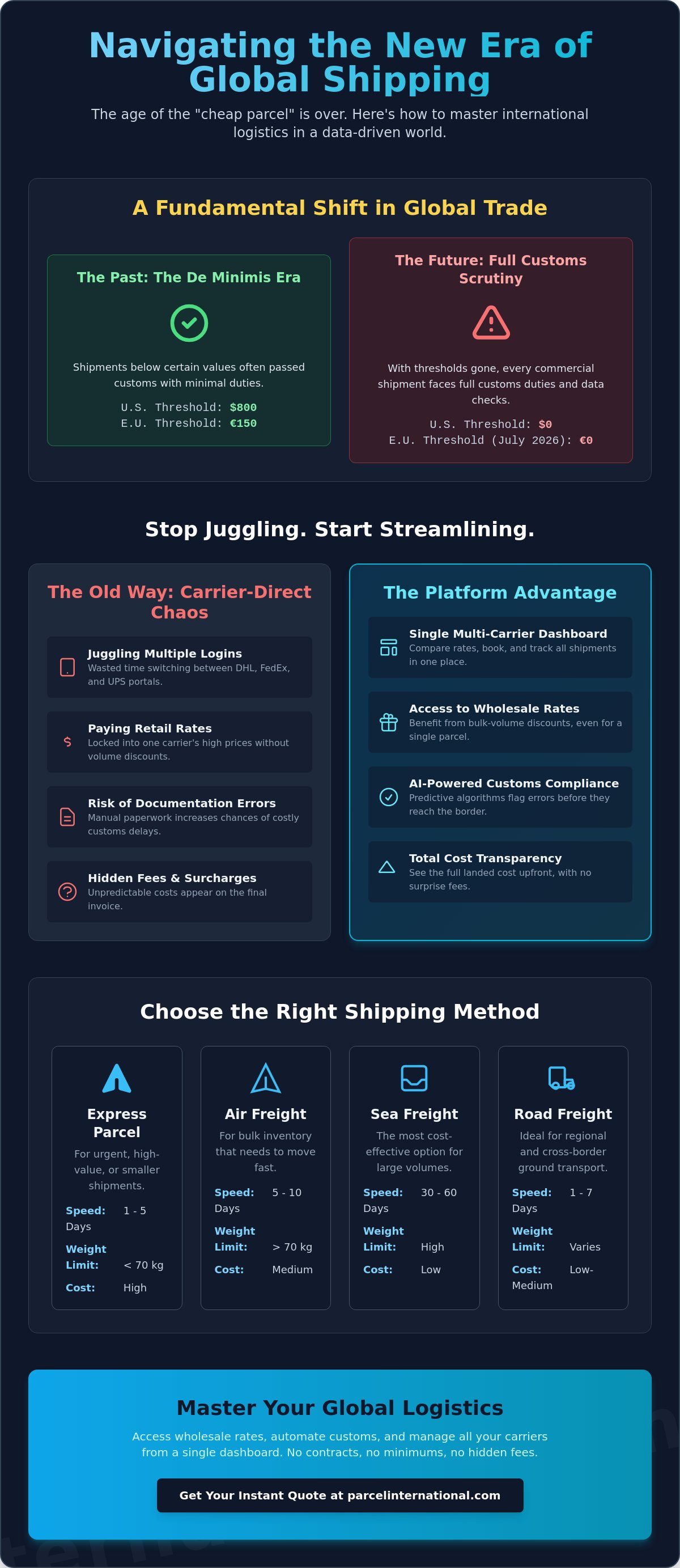
The era of the "cheap parcel" is officially over. With the U.S. suspension of the $800 de minimis exemption and the EU's removal of the €150 threshold on July 1, 2026, every commercial shipment now faces the full weight of customs duties. If you want to ship international successfully, you can't just pick a carrier and hope for the best. You need a platform strategy that accounts for a world where global air cargo rates average $3.29 per kilogram and customs enforcement is entirely data-driven.
It's exhausting to juggle separate logins for DHL, FedEx, and UPS while worrying if your paperwork will trigger a border delay. We understand the frustration of unpredictable costs and the "catch" often hidden in traditional logistics contracts. This guide promises to help you master these complexities. You'll learn how to secure wholesale shipping rates, automate your customs forms, and manage every global shipment from a single, streamlined dashboard.
Key Takeaways
Transition from carrier-direct booking to a platform-based model to simplify the multi-stage logistics process.
Identify the right moment to switch from express shipping to sea, air, or road freight for maximum cost-efficiency.
Perfect your commercial invoice and documentation to bypass delays and keep your cargo moving through global checkpoints.
Access exclusive wholesale rates to ship international with confidence, even without high-volume corporate contracts or minimum orders.
Use a single multi-carrier dashboard to compare top providers like DHL, FedEx, and UPS without the hassle of hidden fees or subscriptions.
Table of Contents
What Does it Mean to Ship International in 2026?
In 2026, the process to ship international has evolved from a simple transaction into a high-stakes, multi-stage logistics journey. It's no longer just about putting a label on a box and crossing your fingers. A standard shipment now involves a coordinated sequence of export clearance, international transit through major hubs, and rigorous data-driven import inspections. If you're still booking directly with a single carrier, you're likely overpaying and missing out on the flexibility required to survive in a volatile global market.
Traditional carrier-direct booking is becoming a relic of the past. Why lock yourself into one carrier's pricing and schedule when the market changes daily? The industry has shifted toward platform-based aggregation. This model allows you to compare rates from multiple providers in one place, ensuring you always get the most cost-effective route. There's no catch to this approach; it's simply a more efficient way to manage global commerce without being tethered to a single provider's limitations.
Stop juggling multiple carrier accounts. It's the #1 efficiency killer for growing businesses. When you're forced to log into three different portals to track three different packages, you're wasting time that should be spent on your core business. Consolidating your logistics into a single dashboard provides instant relief. You get one point of contact, one set of invoices, and a unified view of your entire supply chain.
The Netherlands, specifically the Port of Rotterdam, remains a vital gateway for global freight transport, connecting international markets to the heart of Europe. As a "Trusted Partner" with over 15 years of experience in this region, we've seen how this hub streamlines the movement of express, sea, and air freight. Leveraging this infrastructure is key to ensuring your goods move through customs without unnecessary delays.
The Different Players in Global Logistics
Primary Carriers: Companies like FedEx, DHL, and UPS provide the physical infrastructure, including the planes and trucks that move your cargo.
National Postal Networks: While traditional postal options are often cheaper, they usually lack the granular tracking and speed required for commercial shipments in a modern economy.
Logistics Brokers: These experts secure wholesale rates by pooling volume from thousands of users. They pass these savings to you, allowing even small shippers to access corporate-level pricing.
Freight Forwarders: These partners take over when your cargo outgrows a standard box, managing complex air, sea, and road freight movements.
Key Trends Shaping Shipping in 2026
Transparency is now the standard for anyone looking to ship international. You shouldn't have to deal with hidden brokerage fees or surprise surcharges upon delivery. Modern platforms provide real-time rate transparency, showing the total landed cost upfront. Sustainability has also moved from a niche concern to a core requirement. You can now choose green routing and carbon-neutral options to meet environmental goals. Finally, AI is transforming the "Customs Black Hole." Predictive algorithms now flag potential paperwork errors before they reach the border, significantly reducing the risk of packages being held for weeks.
Selecting the Optimal Shipping Method for Your Cargo
Choosing how to ship international shouldn't feel like a gamble. Most businesses start with express parcels because they're fast and familiar. But as your volume grows, the cost per unit can eat your margins. Understanding International Shipping Basics helps you decide when to stick with a courier and when to move to freight. The decision usually boils down to a simple trade-off: how much are you willing to pay for speed?
Express shipping remains the gold standard for e-commerce. It's built for urgency and high-value items. One major advantage for growing brands is the "No Minimum Order" policy. In the past, only corporate giants got the best rates. Today, you can access those same wholesale prices for a single box. This flexibility allows you to test new markets without the risk of heavy upfront logistics costs. Don't wait for a full pallet to start your global expansion.
When your cargo outgrows a standard box, it's time to transition to freight. This shift is necessary when you're moving bulk inventory or oversized items that exceed the typical 68-70kg limit of express carriers. Evaluating speed versus cost requires a clear framework. For example, if you're importing from China to Europe in 2026, air freight rates sit around $4.80 per kilogram. It's fast but expensive. Conversely, a 40ft container from Shanghai to Los Angeles costs roughly $3,000. It takes much longer, but the ROI on bulk goods is unbeatable. You can compare these freight methods in seconds using our platform to see which fits your current margin.
Express Parcel Delivery: Speed and Security
Door-to-door service is the ultimate relief for small business owners. It removes "last mile" anxiety by handling the package from your desk to the customer's porch. This is critical because last-mile delivery now accounts for 53% of total shipping costs, averaging $7.96 per order. Real-time 24/7 tracking is no longer optional. Customers expect to see every milestone, and having that data at your fingertips prevents the "juggling" of multiple tracking numbers.
Freight Solutions: Air, Sea, and Road
Air Freight: The best choice for high-value, time-sensitive cargo. Global average rates in May 2026 are approximately $3.29 per kilogram.
Sea Freight: Use this to maximize ROI for large-scale inventory. While slower, it's the most cost-effective way to move massive volumes across oceans.
Road Freight: This is the backbone of the European market. By utilizing hubs like Rotterdam, you can move goods across the continent with speed and reliability.
Mastering Customs Documentation and Global Compliance
Master your paperwork to master the border. When you ship international, the Commercial Invoice is the single most important document you'll ever handle. It acts as the "DNA" of your shipment, telling customs officials exactly what's inside, why it's moving, and who is responsible for the costs. If this document is incomplete, your goods won't just be delayed; they'll vanish into the "Customs Black Hole." This is the place where packages sit for weeks because of a missing signature or a vague item description. We provide the customs support needed to ensure your paperwork is airtight before the carrier even arrives.
The logistics landscape in 2026 is defined by data-driven enforcement. U.S. Customs and Border Protection (CBP) and EU authorities now use automated systems to flag inconsistencies in real time. To stay ahead, you must use automated customs tools. These systems remove human error by pulling data directly from your order details to generate compliant forms. This isn't a luxury; it's a necessity for maintaining a seamless supply chain. Our platform offers these tools as a standard part of the process. There's no catch and no hidden fee for compliance.
Understanding Incoterms is equally vital. These rules define whether you or your customer pays for duties, taxes, and insurance. Most e-commerce brands prefer DDP (Delivered Duty Paid), where the shipper handles all costs, providing a friction-free experience for the buyer. However, DAP (Delivered at Place) might be better for high-value freight where the buyer handles the import fees. Clear communication on these terms prevents "doorstep shock" for your customers and keeps your reputation as a Trusted Partner intact.
A Step-by-Step Guide to Customs Clearance
First, identify the correct HS Code (Harmonized System) for your product. This six-to-ten digit number determines your duty rate. Second, check the "De Minimis" threshold for your destination. As of February 2026, the U.S. has suspended the $800 exemption, meaning all commercial shipments now face duties. In the EU, the €150 duty exemption will be removed on July 1, 2026. For Canada, the threshold remains CAD $20 for most countries. Always calculate these duties before your package leaves the warehouse to avoid unexpected brokerage fees.
Common Customs Pitfalls and How to Avoid Them
Vague descriptions: Never use "gift" or "merchandise." Be specific, like "100% Cotton Men's T-shirt."
Incorrect valuation: Under-declaring the value of goods to save on duties is a high-risk strategy. CBP has enhanced its enforcement dashboards in 2026 to catch these discrepancies instantly.
Prohibited items: Every territory has a unique list of restricted goods. Check the specific regulations for the 220+ territories you serve before you ship international to prevent costly seizures.
Strategies to Reduce International Shipping Costs
Stop overpaying for your global reach. Most carriers reserve their most aggressive discounts for high-volume corporate accounts. However, you can access these same wholesale rates without a long-term contract or a minimum order requirement. By using a platform that aggregates volume from thousands of users, even a single shipment gets "big business" pricing. This level of accessibility is a game-changer for small to mid-sized enterprises looking to ship international without draining their budget on every label.
Watch your box size carefully. Dimensional weight (DIM) is a pricing technique used by all major carriers where they charge you based on the space a package occupies, not just its physical weight. If you ship a small item in a massive box, you're effectively paying for air. Optimizing your packaging to fit the contents snugly is one of the fastest ways to cut costs. Smaller boxes mean lower DIM weight and immediate savings. Combine multiple orders into a single consolidated shipment when possible to further reduce the per-unit cost of transport.
Forget monthly fees and hidden "access" charges. Traditional logistics software often locks you into expensive subscriptions that eat into your margins. Our "No Subscription" model means you only pay for what you use. There are no monthly dues and no catch. This transparency ensures that your logistics costs scale naturally with your sales. It provides the financial relief you need to grow sustainably without worrying about a fixed overhead cost for your shipping platform. Ready to stop overpaying? Get your free wholesale shipping quote today and see how much you can save.
Comparing Rates Like a Pro
Don't settle for the first quote you see. Carriers only show you their own rates, which prevents true price transparency. Use a multi-carrier shipping calculator to view real-time estimates from all top providers side-by-side. Be on the lookout for hidden fees like fuel surcharges, residential delivery fees, or peak season spikes that can inflate your final bill. Our "No Catch" philosophy means the rate you see is the rate you pay; we prioritize transparency so you can ship international with total confidence in your margins.
Operational Efficiency for Small Businesses
Time is your most valuable resource. Streamlining your labels and customs documentation can save dozens of man-hours every week. Instead of manually entering data for every carrier, use a unified system that pulls order details automatically. If a problem arises, leverage 24/7 support to solve it before it becomes a costly delay. A single package stuck at the border can lead to storage fees or lost customers. Finally, reduce return costs by establishing clear international shipping policies that set expectations for duties and taxes upfront.
Why a Multi-Carrier Platform is Your Best Logistics Ally
Carriers want you locked into their specific ecosystem. If you use a single-carrier portal, you're at the mercy of their specific rate hikes and capacity limitations. A multi-carrier platform provides essential neutrality. We work for you, not the carrier. This allows you to ship international while maintaining total control over your margins. By seeing DHL, FedEx, and UPS side-by-side, you ensure that no single provider's price increase disrupts your bottom line. You gain the power to choose the most efficient route for every single package.
Since 2007, we've acted as a Trusted Partner for businesses ranging from independent startups to large-scale commercial projects. We've spent over 15 years building deep industry relationships to secure the exclusive rates you see on our platform. The primary relief comes from simplicity. You get one dashboard and one consolidated invoice for shipments heading to 220+ destinations. Stop the "juggling" of multiple logins and confusing paperwork. Everything you need to manage your global supply chain is in one place, organized and accessible.
Growth shouldn't be complicated. Your logistics partner must scale with you. Whether you're sending your first express parcel or moving your first full sea freight container, the process remains the same. You don't need to find a new provider every time your volume increases. You can transition from road freight across Europe to air freight from Asia within the same user-friendly interface. This consistency is vital for maintaining a stable supply chain as you expand your global footprint and reach new customers in distant markets.
The Parcel International Difference
No barriers to entry: We have removed the subscription fees and minimum order requirements that hold most businesses back.
Elite carrier access: You get the same corporate-level access to top-tier carriers like DHL, FedEx, and UPS regardless of your shipment volume.
Superior support: Our dedicated team is available 24/7, providing a level of care that exceeds what you'd get booking directly with a carrier. We handle the heavy lifting of customs support and brokerage fees.
Getting Started: Your First Shipment
You can start today without the hassle of long-term contracts. Use our rate comparison tool to get a quote in under 60 seconds. Once you set up your business profile, our system handles the automated documentation for your commercial invoices. This ensures you ship international with compliance built-in from day one. Don't waste time with outdated, manual systems. Streamline your global shipments with Parcel International today.
Master Your Global Supply Chain Today
The logistics landscape of 2026 requires more than just a courier service; it demands a strategic partnership. You now have the roadmap to navigate new customs regulations and the framework to choose between express and freight based on real-time data. By automating your documentation and consolidating your view into a single dashboard, you can finally stop the exhausting cycle of juggling multiple carrier accounts. Efficiency is no longer a luxury reserved for industry giants.
Since 2007, we've served as a Trusted Partner for businesses aiming to ship international with total transparency. You don't need a high-volume corporate contract to access exclusive wholesale rates from DHL, FedEx, and UPS. Our platform includes automated customs documentation as a standard feature to ensure your cargo moves through borders without the typical hassle. There's no catch and no subscription required to start optimizing your supply chain today.
Compare rates and ship international with no catch to take control of your global strategy. You have the tools and the knowledge. Now it's time to scale with confidence.
Frequently Asked Questions
How do I choose the cheapest way to ship international?
The cheapest way to ship international is to compare real-time rates across multiple carriers and optimize your packaging to reduce dimensional weight. By using an aggregator platform, you access wholesale rates usually reserved for high-volume corporate accounts. This allows you to select the most cost-effective route for air, sea, or road freight without the need for a long-term contract or a minimum order volume.
What documents are required for international parcel shipping?
Every commercial shipment requires a detailed Commercial Invoice and a Packing List. These documents act as the "DNA" of your package, providing customs officials with specific item descriptions, values, and HS codes. Some destinations also require a Certificate of Origin or specific permits for restricted goods. Using automated tools ensures your paperwork is compliant and reduces the risk of human error that leads to border delays.
How long does express international shipping usually take?
Express international shipping typically delivers within 1 to 5 business days, depending on the destination's proximity to major logistics hubs like Rotterdam. For instance, a parcel moving from Europe to a major U.S. city often arrives in 2 to 3 days. While these services prioritize speed, actual delivery times depend on how quickly your goods clear customs inspections and the efficiency of the local delivery network.
Do I need a subscription to get discounted shipping rates?
You don't need a subscription or a monthly fee to access discounted shipping rates. Our "No Catch" philosophy means you only pay for the shipments you create. This flexibility allows small businesses to enjoy the same competitive pricing as global giants without the burden of fixed monthly overhead or hidden access fees. You simply compare, select, and ship international with total transparency.
What is the difference between air freight and express shipping?
Express shipping is a door-to-door service designed for parcels under 70kg, whereas air freight is a more complex solution for larger, palletized cargo. While both utilize aircraft, air freight often involves airport-to-airport transit and requires separate arrangements for local pickup and delivery. Choose express for speed and convenience; use air freight when moving bulk inventory that exceeds standard courier weight limits to maximize your ROI.
How are international shipping duties and taxes calculated?
Duties and taxes are calculated based on the Harmonized System (HS) code of your product, its declared value, and the destination country's tax laws. Since the U.S. suspended the $800 de minimis exemption in early 2026, most commercial shipments now incur duties regardless of value. Our platform helps you calculate these costs upfront so you can decide whether to use DDP or DAP terms for your customer.
Can I track my international parcel through multiple carriers in one place?
You can track every shipment from DHL, FedEx, and UPS within a single, unified dashboard. This eliminates the need to visit multiple carrier websites to check statuses. Having 24/7 visibility in one location provides the relief of knowing exactly where your cargo is at any moment. This streamlined approach removes the inefficiency of "juggling" different platforms and keeps your global supply chain organized and predictable.
What happens if my package gets stuck in customs?
If a package gets stuck, we provide direct customs support to identify the specific reason for the hold and help you resolve it. Most delays occur due to vague item descriptions or missing documentation. As your Trusted Partner, we help you submit the necessary information to customs officials to get your package moving again. Our proactive support exceeds standard carrier service levels to ensure your business stays on schedule.


