
International Parcel Shipping: The Ultimate 2026 Guide to Global Delivery
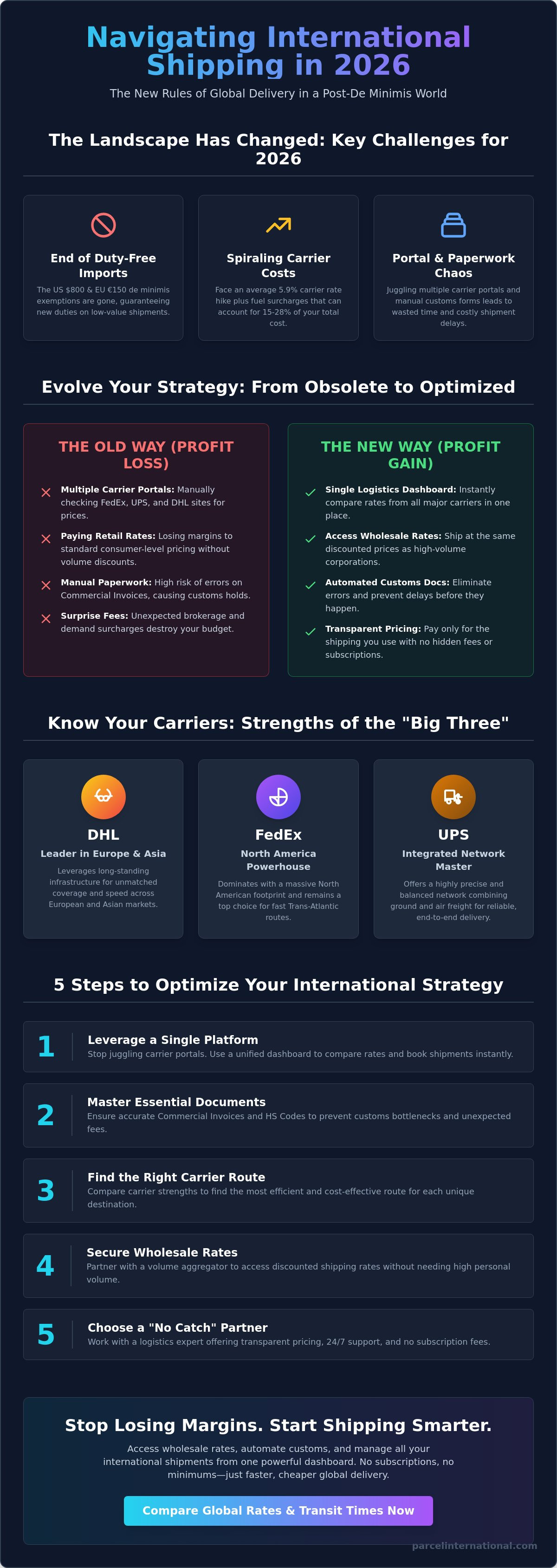
In 2026, the era of frictionless, duty-free imports has officially ended. With the United States suspending the $800 de minimis exemption and the EU removing its €150 threshold on July 1, the old way of handling international parcel shipping is now a guaranteed recipe for customs delays and profit loss. You likely feel the pressure of these changes every time you see a 5.9% carrier rate hike or a surprise brokerage fee. It's exhausting to watch your margins vanish while you're stuck juggling multiple carrier portals just to find a fair price.
This guide will show you how to reclaim your profits by accessing wholesale rates usually reserved for high-volume shippers and automating your customs paperwork to stop delays before they start. We'll walk through the process of using a single dashboard to compare FedEx, UPS, and DHL instantly while mastering the complex 2026 regulatory landscape. You don't have to settle for retail rates or manual paperwork; it's time to streamline your global delivery with a clear, no-nonsense strategy that ensures your parcels arrive faster and cheaper.
Key Takeaways
Stop juggling multiple carrier portals and learn how to leverage platform-based logistics to streamline your global delivery.
Compare the strengths of the "Big Three" carriers to find the most efficient international parcel shipping routes for your business.
Master essential documentation, including Commercial Invoices and HS Codes, to prevent customs bottlenecks and unexpected fees.
Implement a cost-saving strategy that reduces dimensional weight and secures wholesale rates without the need for high volumes.
Partner with a "no catch" logistics expert to access 24/7 support and transparent pricing with no subscription fees or minimum orders.
Table of Contents
What is International Parcel Shipping in 2026?
International parcel shipping is the cross-border movement of goods through coordinated express, air, or road networks. In 2026, this process is no longer a simple transaction between a sender and a single carrier. As global parcel delivery volumes are projected to reach 435 billion packages this year, the industry has shifted toward a more sophisticated, data-driven model. It's a high-stakes environment where speed is expected, but cost control is the ultimate competitive advantage.
The standard method of booking directly with a carrier is quickly becoming obsolete for savvy businesses. In previous years, you might have logged into individual FedEx or UPS portals, but the 2026 market demands more agility. Carriers implemented average rate increases of 5.9% at the start of the year, and fuel surcharges now account for 15% to 28% of total shipping costs. Relying on a single carrier's retail pricing is a fast way to lose your margins. This reality has fueled the rise of platform-based logistics brokerage, which allows you to manage everything from one central dashboard.
Volatility is the new normal. Between the elimination of de minimis duty exemptions in the U.S. and EU and the constant flux of "demand" surcharges, real-time rate comparison is a survival tool. You can't guess what a shipment will cost based on last month's data. Modern platforms give you instant access to wholesale rates that were once reserved only for the world's largest retailers. By using a broker, small and medium businesses can bypass expensive retail margins and ship at the same price points as high-volume corporations.
The Logistics Spectrum: Parcels vs. Freight
Choosing the right mode of transport is your first step toward optimization. Use Express Shipping for small parcels, which are typically defined as shipments under 70kg. These move through rapid global networks and offer the best balance of speed and tracking. If your cargo is bulkier or doesn't require overnight arrival, transition to Air Freight or Sea Freight. For regional distribution within Europe, Road Freight through major hubs like Rotterdam provides a cost-effective alternative for heavy goods that don't need the premium price tag of a plane wing.
The "No Catch" Philosophy of Modern Brokers
Many shippers worry that using a third-party platform means dealing with hidden fees or complicated subscriptions. The reality is quite the opposite. A logistics broker is a volume aggregator that passes wholesale savings to the end-user without membership fees. These platforms don't need to charge you a monthly "access fee" because they earn their revenue from the carrier's wholesale margins. This model ensures you get a "no catch" experience where you only pay for the shipping you actually use, backed by 24/7 support that often exceeds the service levels of the carriers themselves.
Understanding the International Shipping Ecosystem
Don't waste time trying to master every carrier's internal network on your own. The global ecosystem is built on a few giants, but their strengths aren't equal across every continent. DHL, FedEx, and UPS control the majority of international parcel shipping lanes, yet they serve different strategic purposes. DHL typically leads in European and Asian markets due to its long-standing infrastructure. FedEx has a massive footprint in North America and remains a powerhouse for Trans-Atlantic routes. UPS offers a highly integrated network that balances ground and air freight with incredible precision.
National postal services provide a cheaper alternative for non-urgent mail. However, they often lack the granular tracking and speed required for modern commercial growth. When your goods land at a major global hub like Rotterdam, the efficiency of that port dictates your final delivery speed. This is where the "last-mile" challenge begins. The final leg from a regional hub to a customer's door is the most complex part of the journey. Reliability here depends on how well your chosen carrier handles local hand-offs.
Understanding how these carriers interact with government agencies is vital to avoiding delays. You must stay informed on the specific rules for customs and duties for international shipping when your parcels enter the U.S. network. A single documentation error can leave your package sitting in a warehouse for weeks. To keep your logistics moving, you can compare global rates and transit times through a single dashboard rather than checking each carrier manually.
Express vs. Standard: Calculating the Value of Speed
In 2026, "Express Shipping" means a global delivery window of 1 to 3 days. If you choose standard shipping to save a few dollars, you risk customer dissatisfaction and negative reviews. Standard shipping often lacks 24/7 tracking transparency, leaving both you and your customer in the dark. For high-value goods, the security and speed of an express network far outweigh the initial cost savings of a slower postal route.
Carrier Specialisations and Route Optimisation
Carriers often dominate specific trade lanes. One might offer the best rates to Singapore while another wins on shipments to Mexico. Managing these variables manually leads to the "juggling" problem, where you waste hours in different portals. A streamlined platform does the route-matching for you, selecting the best carrier for every specific destination. This ensures you always get the most efficient path without the hassle of individual carrier contracts. By analyzing UPS International Shipping vs. DHL: Choosing the Best, you can align your strategy with the strengths of each network.
Navigating Customs, Duties, and Documentation
Customs shouldn't be a black box that swallows your profits and delays your deliveries. The Commercial Invoice is the heart of every international parcel shipping transaction. It's the primary document that tax authorities use to determine the legality, origin, and value of your goods. If this document is missing, vague, or contains errors, your package stops moving immediately. You must treat this paperwork with the same precision as your product manufacturing.
You also need to master HS Codes (Harmonised System). These six-to-ten digit numbers are a global language for product classification. They dictate exactly how much duty you'll pay. Using the wrong code doesn't just lead to overpayment; it can result in heavy fines for misclassification. In a world where regulations change overnight, getting these codes right is the difference between a seamless delivery and a legal headache.
The 2026 regulatory environment is the most challenging in decades for small shippers. The United States officially suspended the $800 de minimis exemption for e-commerce via Executive Order 14324 in February 2026. This means even low-value items now require formal customs entry. Similarly, the European Union is set to remove its €150 customs duty exemption on July 1, 2026. Thailand already abolished its exemptions for shipments below ฿1,500 in January 2026. These shifts mean that almost every commercial parcel now faces duties and taxes that didn't exist a year ago.
Automating Compliance to Avoid Delays
Manual paper forms are a relic of the past and a major liability. The industry has shifted toward integrated digital customs data to speed up border crossings. Parcel International’s automated tools extract data directly from your booking to generate compliant documentation. This prevents the dreaded "brokerage fee" surprise, which happens when a carrier has to manually correct your forms at the border. Common pitfalls like using vague descriptions such as "samples" or "electronics" will trigger an audit. Be specific. Instead of "clothing," use "100% cotton men's knitted sweaters."
Managing Import Duties and Taxes
You must decide between DDU (Delivered Duty Unpaid) and DDP (Delivered Duty Paid). With DDU, your customer receives a surprise bill from the courier before they can get their package. This often leads to refused deliveries and brand damage. DDP allows you to pay those costs upfront, providing a much better experience for the buyer. It's essential to understand your responsibilities within the international shipping ecosystem to ensure you're setting clear expectations. Customs delays are rarely caused by the carrier, but by incomplete data provided at the point of booking.
5 Steps to Optimising Your International Parcel Strategy
Don't leave your logistics to chance. High-volume carriers like FedEx and UPS increase their rates annually, with 2026 seeing average hikes of 5.9% across the board. To stay competitive, you need a disciplined approach to international parcel shipping that prioritises efficiency over habit. Follow these five steps to take control of your global delivery and protect your profit margins.
Step 1: Compare Rates. Use a shipping cost calculator to see real-time carrier options on one screen. This removes the need for manual searching and ensures you never pay retail prices.
Step 2: Optimise Packaging. Reduce your dimensional weight by choosing the smallest possible box. Carriers charge for the space you occupy, not just the physical weight.
Step 3: Automate Documentation. Ensure HS codes and commercial invoices are generated via your platform. Digital automation prevents the manual errors that lead to customs delays.
Step 4: Select Insurance. Protect your high-value goods against transit damage or loss. Transit insurance is a small price to pay for total peace of mind.
Step 5: Track and Communicate. Provide your customers with real-time updates. This reduces "where is my parcel" inquiries and improves the post-purchase experience.
Ready to see these steps in action? Compare real-time shipping rates now to find the most cost-effective route for your next delivery.
Reducing Costs Through Dimensional Weight Management
Dimensional weight, or "Dim Weight," is a formula used by carriers to bill for the volume of a package. In 2026, the standard divisor is typically 5000. This means a large, light box can cost more than a small, heavy one. Stop paying to ship air. Choose custom packaging that fits your product snugly or use standard flat-rate boxes to keep your costs predictable and low. Every centimetre you shave off your box dimensions directly impacts your bottom line.
Scaling with a Logistics Partner
Stop juggling multiple carrier accounts. It's an inefficient way to run a business and often leads to missed savings. A single logistics partner acts as a "streamliner," providing one dashboard for DHL, FedEx, and UPS. This gives you a single point of contact for support and access to exclusive wholesale rates without the need for high minimum order volumes. You get the reliability of a "Trusted Partner" that handles the complexities, allowing you to focus on growing your brand instead of managing paperwork.
Why Parcel International is Your "No Catch" Global Partner
Choosing a logistics partner shouldn't feel like signing a restrictive contract. Our "No Catch" philosophy means you get access to top-tier carriers without the burden of monthly subscriptions or minimum order requirements. We've built our business on the belief that international parcel shipping should be accessible to everyone, from small e-commerce startups to large industrial exporters. You only pay for what you ship. You always get the benefit of our wholesale margins. This egalitarian approach removes the barriers that often keep smaller businesses from competing on a global scale.
While giants like DHL, FedEx, and UPS provide the physical infrastructure, they often lack the personalized, high-touch support a growing business needs. We fill that gap with 24/7 customer support that exceeds the service level of direct carrier bookings. If a shipment gets flagged at a border or a route is disrupted, you don't have to navigate a labyrinth of automated phone menus. You have a dedicated ally ready to resolve issues in real-time. Whether you're sending a single express envelope or managing complex sea freight projects, we provide the same level of professional oversight and customs support.
We position ourselves as more than just a middleman. We're a "streamliner" that takes a chaotic process and makes it orderly. By removing the need for multiple carrier accounts, we eliminate the mental load of managing different pricing structures and documentation requirements. Our platform is a singular, transparent solution designed to give you peace of mind in a high-stakes industry where hidden costs are unfortunately common.
Streamline Your Shipments Today
You can get started in minutes without a complex setup process or credit checks. Our platform provides a unified dashboard that allows you to "stop juggling" different portals and start shipping with confidence. For businesses looking to expand into Europe, our Rotterdam-based hub offers a massive strategic advantage. We leverage this location to provide superior road freight and sea freight connections, ensuring your goods move through the most efficient trade lanes in the world. It's about making global logistics feel local and manageable.
A Legacy of Reliability Since 2007
We aren't a new tech startup trying to figure out the rules on the fly. With nearly two decades of experience since 2007, we've navigated every major shift in global trade and carrier policy. While our technology is automated and fast, it's backed by human experts who understand the nuances of the international parcel shipping market. We're more than just a software platform; we're a Trusted Partner committed to your long-term success. Experience the relief of a logistics process that finally works for you.
Don't let complex logistics hold your business back. Compare, Select, and Ship with Parcel International to start saving time and money on every shipment.
Master Your Global Delivery Strategy in 2026
The landscape of international parcel shipping has shifted toward complexity, but it doesn't have to be a burden on your business. You now know that success in 2026 depends on adapting to new de minimis rules and moving away from the inefficiency of juggling individual carrier accounts. By centralizing your logistics, you avoid the trap of retail price hikes and ensure your documentation is always border-ready. It's about moving from reactive shipping to a proactive, automated strategy that protects your margins.
Take the next step by choosing a partner that values transparency. With no subscription fees or minimum order requirements, you can access exclusive wholesale rates from DHL, FedEx, and UPS immediately. Our 24/7 dedicated support ensures your international shipments never get stuck in a digital void. Stop letting high costs and complex paperwork slow your growth. Streamline your global logistics and compare rates today to see how simple global delivery can be. Your brand is ready to reach the world; we're here to make sure it gets there without the hassle.
Frequently Asked Questions
How do I find the cheapest international shipping rates for my business?
You find the cheapest rates by using a platform that aggregates volume to secure wholesale pricing from major carriers. Don't book directly through carrier websites where you'll pay high retail margins. Our dashboard lets you compare DHL, FedEx, and UPS side by side to select the most cost-effective option for every specific route. This strategy ensures you benefit from bulk-shipping discounts even if you're only sending a single package.
What is the difference between express shipping and freight forwarding?
Express shipping is designed for smaller parcels, typically under 70kg, moving through rapid air networks with 1 to 3 day delivery. Freight forwarding handles large-scale, palletized cargo or full containers via sea, air, or road freight. While express is a door-to-door service, freight forwarding involves more complex logistics, including port-to-port movements and consolidated shipments for bulkier, less time-sensitive goods that don't fit into standard parcel networks.
Can I ship a parcel internationally without a commercial invoice?
You cannot ship a parcel internationally without a commercial invoice if it contains anything other than paper documents. This document is mandatory for customs authorities to verify the contents and value of your shipment. Without it, your package will be rejected at the border or held indefinitely. Our automated tools generate this paperwork during the booking process to ensure your international parcel shipping complies with all 2026 global regulations.
How are international shipping duties and taxes calculated?
Duties and taxes are calculated based on the HS code of your product, the declared value on the commercial invoice, and the specific trade laws of the destination country. In 2026, many countries have removed de minimis exemptions, meaning duties often apply from the first dollar of value. Factors like the country of origin and current trade agreements also play a role in the final bill determined by customs officials at the border.
What happens if my international parcel is stuck in customs?
If your parcel is stuck, it's usually due to incomplete documentation or unpaid duties. Check your tracking status immediately for "Clearance Delay" notifications. You should contact your logistics partner or the carrier to provide any missing information, such as a specific tax ID or a more detailed item description. We provide 24/7 support to help resolve these bottlenecks quickly and keep your shipments moving without unnecessary storage fees.
Is there a minimum number of parcels I need to ship to get a discount?
There is no minimum number of parcels required to access discounted rates through our platform. We operate on a "no minimum order" policy, allowing small businesses to enjoy the same wholesale savings as high-volume shippers. Whether you ship once a month or several times a day, you get the same transparent pricing and professional service without being locked into a restrictive contract or expensive monthly subscription.
How do I track a parcel across different international carriers?
You can track all your shipments from a single, unified dashboard regardless of which carrier is handling the delivery. This removes the need for "juggling" different tracking websites for DHL, FedEx, and UPS. You get real-time updates and can provide your customers with a single tracking link. This centralized approach reduces administrative work and ensures you always have clear visibility over your global logistics from departure to final arrival.
What items are prohibited for international parcel shipping in 2026?
Prohibited items for international parcel shipping in 2026 include hazardous materials, lithium batteries not installed in equipment, and counterfeit goods. Perishable items and certain high-tech components are also heavily restricted depending on the destination country's current trade policies. Always check the specific carrier's prohibited items list before booking to avoid fines or shipment destruction. Our customs support team can help clarify restrictions for specific global markets.


