
Shipping Cost Explained: How to Calculate and Lower Your Rates in 2026
Updated: May 15
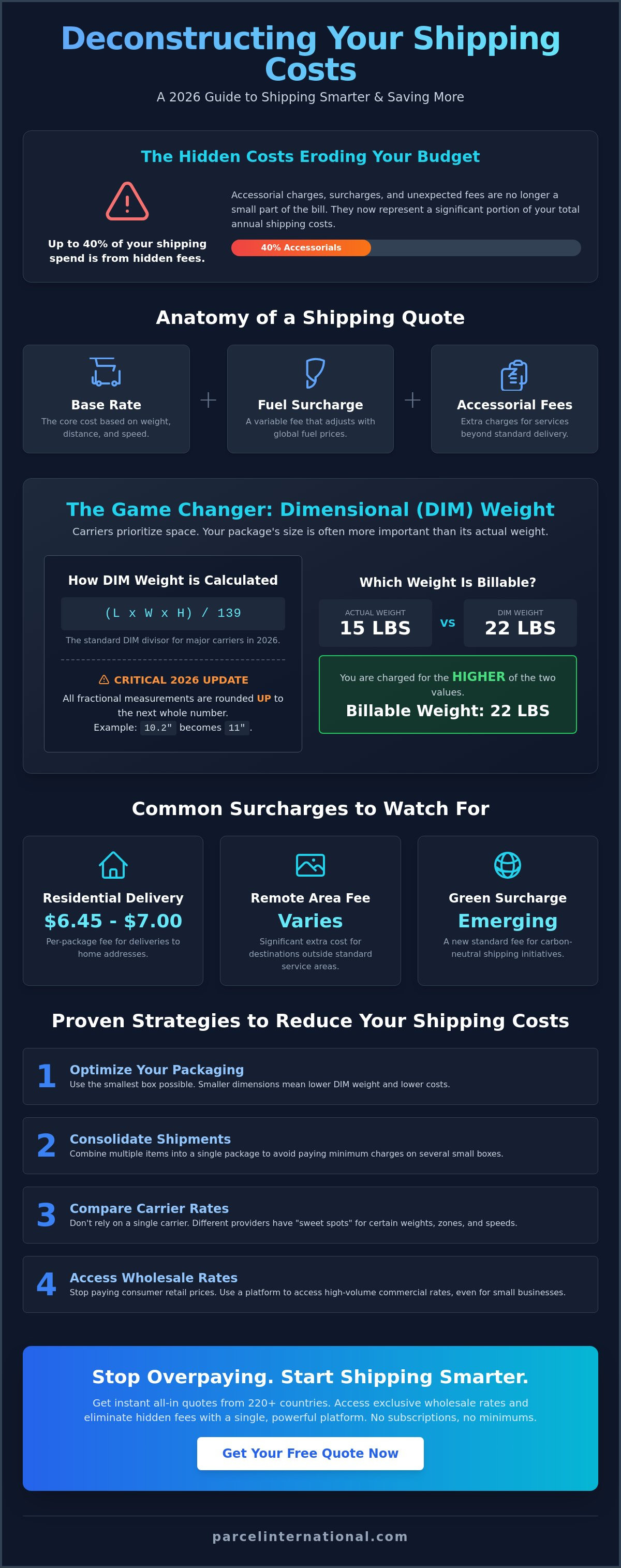
Accessorial charges now account for up to 40% of your total annual shipping cost. With major logistics providers implementing general rate increases of 5.9% and additional regional surcharges through 2027, the price of moving goods has reached a new peak. It's frustrating to book a shipment only to see hidden fees or "out-of-zone" costs appear on your final invoice. You're likely tired of juggling multiple carrier websites and wrestling with dimensional weight math that now rounds every fractional inch up to the next whole number.
We believe logistics should be a source of growth, not anxiety. You can master the variables behind your shipping cost and secure exclusive wholesale rates without the typical logistics hassle or hidden fees. This guide breaks down the specific 2026 rate changes, explains the updated DIM weight divisors, and provides a roadmap to automating your customs paperwork for a truly predictable budget.
Key Takeaways
Understand that your total shipping cost is a composite of base rates, fuel surcharges, and service fees rather than a single fixed number.
Learn why carriers prioritize space over weight and how to master the dimensional weight formula to avoid unexpected billing adjustments.
Discover the specific "sweet spots" for major carriers like DHL, UPS, and FedEx to ensure you choose the most cost-effective provider for every destination.
Apply proven strategies like package optimization and parcel consolidation to strip away unnecessary surcharges and "box-in-box" traps.
See how to access wholesale rates and instant multi-carrier comparisons for over 220 countries without the burden of monthly subscriptions or minimum orders.
Table of Contents
What Factors Actually Determine Your Shipping Cost?
Your shipping cost isn't a single flat fee. It's a complex calculation that combines several moving parts. Carriers start with a base rate and then layer on fuel surcharges and specific service fees. Understanding how freight rates are determined helps you see through the noise and identify where your money is actually going. Most shippers are caught off guard by the fact that accessorial charges, such as residential delivery fees or brokerage costs, now account for 20% to 40% of their total annual expenditure.
The "Big Three" variables-weight, distance, and speed-form the foundation of every quote. Heavier items naturally cost more because they consume more fuel and physical space. Distance is measured through a system of zones, while speed is the premium you pay for priority handling. When you ship from a major U.S. logistics hub, the math changes in your favor. Because these hubs (like Los Angeles, Chicago, or Memphis) are primary gateways for domestic and international freight, initial routing costs are often lower due to high carrier density and superior infrastructure. If you're moving goods from such a hub, you're starting from one of the most efficient points in the country.
Don't fall into the trap of paying retail rates at a local counter. Those prices are designed for one-off consumers and include a significant markup. Commercial wholesale rates are much lower because they reflect high-volume shipping and automated processing. Parcel International bridges that gap for you. We provide small and medium businesses with the same pricing power as major corporations, stripped of the usual logistics hassle.
The Impact of Distance and Shipping Zones
Carriers divide the world into shipping zones to calculate the effort required for transit. Zone 1 is usually the local area, while higher zones represent the furthest reaches of a network. In 2026, many carriers have tightened these boundaries. However, shipping from a major U.S. hub like Los Angeles or New York to a primary city in the Midwest or East Coast is often more cost-effective than an inland-to-inland route. The infrastructure is better and the volume is higher. You can identify your destination zone by checking the carrier's 2026 zone chart, which is updated annually to reflect new infrastructure costs and transit routes.
Delivery Speed vs. Budget Constraints
Choosing between Express and Economy is a strategic trade-off. Express services can cost two to three times more than standard road or sea freight. Is that speed worth it? For high-value electronics or time-sensitive legal documents, the answer is usually yes. Modern e-commerce relies on "Time-Definite" delivery to build customer trust. If a buyer needs a package by a specific window, they're often willing to pay for it. For everything else, Economy is your best friend. It keeps your shipping cost low while still providing reliable tracking. Balance your customer's urgency against your bottom line; don't pay for air freight when road freight can get it there in 48 hours for a fraction of the price.
Beyond the Scale: Understanding Dimensional Weight and Surcharges
Carriers prioritize density because their trucks and planes have limited volume. If your package is light but bulky, it takes up space that could have held heavier, more profitable cargo. To solve this, logistics providers use Dimensional (DIM) weight to determine your final shipping cost. Beyond the base price, you'll likely encounter common "hidden" surcharges. Residential delivery fees in the US currently range from $6.45 to $7.00 per package for major carriers in 2026, while remote area fees can add significant weight to your invoice if your destination is off the primary delivery routes.
A growing trend in 2026 is the "Green Surcharge." Many global carriers now offer or mandate fees for carbon-neutral shipping to support industry-wide decarbonization goals. These environmental contributions are becoming a standard line item on many commercial invoices. We believe in total transparency, which is why our platform consolidates these variables into a single price. You can compare these all-in rates instantly to see exactly what you'll pay before you commit to a shipment.
Calculating Dimensional (DIM) Weight
To find your DIM weight, use the universal formula: (Length x Width x Height) / 139. This divisor is the standard for major private carriers in 2026. Carriers then compare this number to the package's actual weight and charge you for whichever is higher, a figure known as the "Billable Weight." Since August 18, 2025, carriers have rounded all fractional inches up to the next whole inch, making precise packing more critical than ever. Empty space in your box is effectively a direct tax on your logistics budget.
Navigating Fuel and Peak Season Surcharges
Fuel surcharges are highly volatile and fluctuate weekly based on global oil prices. For instance, international exports saw a 38.5% fuel surcharge in May 2026 when jet fuel reached $4 per gallon. You also need to prepare for "Peak Season" in the fourth quarter, where demand spikes lead to temporary price hikes across all major networks. Using a platform that updates these surcharges in real-time allows you to lock in rates and avoid "bill shock" after the package has already been delivered. Our system tracks these shifts automatically, so you don't have to spend hours checking carrier bulletins.
Comparing Major Carriers: Why One Quote is Never Enough
Relying on a single carrier is one of the fastest ways to inflate your shipping cost. Data from 2026 shows that price gaps between major providers often range from 25% to 40% for the exact same shipment. Every carrier has a "sweet spot" where their infrastructure allows for lower pricing; however, those spots change based on weight, destination, and the mode of transport. If you only check one platform, you're essentially gambling with your logistics budget. Juggling multiple carrier websites to find these deals is a massive drain on your time. It leads to fragmented tracking and inconsistent billing that makes financial planning nearly impossible.
A logistics aggregator acts as a "single pane of glass" for your business. Instead of logging into four different portals, you see every available option in one view. This transparency strips away the mystery of carrier pricing. It allows you to compare, select, and ship based on real-time data rather than habit. Whether you're moving a small parcel or a full truckload from Rotterdam, seeing the full market ensures you never pay a premium for a service that another provider offers at a wholesale rate.
Carrier Specializations in 2026
In 2026, DHL continues to dominate European road freight, making them a primary choice for cross-border trucking out of Rotterdam. UPS remains the authority for North American domestic routes, while FedEx holds the lead in Trans-Atlantic express air freight. Choosing a carrier isn't just about the price; it's about their local partnerships. A carrier with a strong last-mile network in your destination country will always be more reliable than one relying on third-party handoffs. For e-commerce brands targeting the UK market, you can visit EZ3PL Ltd to learn how specialized fulfillment services can strengthen your regional logistics strategy. Match your carrier to your commodity; use express for high-value goods and road freight for bulkier, less urgent inventory.
The Logistics Broker Advantage
Logistics brokers provide a level of pricing power that small businesses can't reach alone. We aggregate volume from thousands of shippers to negotiate exclusive wholesale rates that are typically reserved for Fortune 500 companies. Our "No Catch" philosophy means you get these rates without monthly subscriptions or minimum order requirements. You simply pay for what you ship. Beyond the lower shipping cost, you gain 24/7 support that often exceeds the service levels of direct carrier bookings. When a delay happens, you don't call a generic hotline; you talk to a partner who manages the resolution for you.
5 Proven Strategies to Reduce Your Shipping Cost Today
Cutting your logistics spend requires more than just a lucky quote. It's about systemic optimization of every parcel you send. Start by avoiding the 'Box-in-Box' trap. Shipping a small item inside a standard carrier box that is then placed inside a larger shipping carton creates massive empty space. This space triggers higher dimensional weight charges, as we discussed in previous sections. Instead, consolidate multiple small parcels into a single freight shipment. Moving ten separate boxes as one road freight shipment from Rotterdam is almost always cheaper than paying for ten individual express labels.
Don't stick with one carrier out of habit. Use multi-carrier platforms to switch providers based on daily price fluctuations and zone-specific sweet spots. If you have high-volume shipping lanes, negotiate flat-rate options for consistent budgeting. These strategies strip away the typical anxieties of international logistics and put the control back in your hands. We act as your Trusted Partner to ensure these wholesale rates are always within reach. There is no catch and no subscription required to access these professional-grade tools.
Packaging Optimization Techniques
Standard carrier supplies are convenient, but they rarely fit your product perfectly. Custom-sized boxes reduce dimensional weight by eliminating excess volume that you are currently paying to ship. Your choice of dunnage also impacts the final bill. Heavy packing peanuts add actual weight; air pillows provide protection without the billable mass. The 'right-size' packaging principle for 2026 dictates that any container with more than two inches of empty space is a direct waste of your capital.
Leveraging Automated Customs Tools
Paperwork errors are a silent budget killer. Incorrect documentation leads to immediate 'Brokerage Fees' and 'Storage Charges' at the border. Automated HS Code classification ensures you apply the correct duty rates from the start, preventing overpayment. A digital-first approach to customs is essential for international growth because it removes the manual entry errors that cause weeks of delays. You can streamline your shipments and automate this paperwork through our platform to keep your goods moving without the hassle.
Streamline Your Logistics with Parcel International
Stop juggling multiple carrier websites and complicated spreadsheets. Our platform provides instant comparisons for shipments to over 220 countries, giving you immediate visibility into your total shipping cost. We built this system to empower small and medium businesses with the same logistics tools used by global corporations. Our "No Subscription, No Catch" philosophy ensures you never pay a monthly fee or a hidden membership charge just to access competitive rates. You simply compare, select, and ship. This transparent approach removes the typical anxieties of international trade and lets you focus on growing your business instead of managing paperwork.
The "No Catch" model is a central pillar of our identity. While many logistics companies hide fees in fine print or require minimum order volumes, we keep it straightforward. You get access to wholesale rates for express, sea, air, and road freight from day one. There's no minimum commitment and no entry barrier. This egalitarian approach makes us a reliable ally for both one-off commercial projects and high-volume daily operations. We strip away the complexity so you can move goods across borders without the hassle.
The Power of a Trusted Logistics Partner
Experience matters in a volatile market. Since 2007, we've spent 19 years building deep relationships with the world's leading carriers. Based in Rotterdam, we have a front-row seat to the most critical logistics hub in Europe. This local expertise allows us to navigate complex global distribution networks with ease. If a shipment hits a snag, you don't have to fight a carrier's automated phone system. Our dedicated support team handles carrier disputes and logistical hurdles on your behalf, acting as your protective advocate 24/7. We exceed the service level of direct carrier bookings by providing a human partner who understands your specific needs.
Getting Started: Your First Quote
Finding your next saving is a fast, logical process. Enter your origin, destination, and the precise dimensions of your package into our calculator. Our system instantly pulls data from across the market to show you the best value-to-speed ratio for your specific lane. Once you've made your choice, the platform guides you through a step-by-step workflow to generate labels and automate customs documentation. Take control of your budget today. Get an instant shipping cost estimate with Parcel International and see how much you can save without the hassle.
Take Control of Your 2026 Logistics Strategy
Mastering your shipping cost requires more than just luck; it demands a clear understanding of carrier math and a refusal to settle for retail rates. We've explored how dimensional weight, regional surcharges, and delivery speed dictate your final bill. By optimizing your packaging and automating customs documentation, you can reclaim your budget from hidden fees and unpredictable price hikes. You don't have to face these logistics hurdles alone or waste time juggling multiple carrier platforms to find the best deal.
As your Trusted Partner since 2007, we provide a streamlined solution that gives you access to wholesale rates across 220+ countries and territories. There are no minimum orders and no subscription fees; just transparent pricing and professional support. Stop guessing and start making data-driven decisions for your business growth. Start comparing international shipping rates for free and experience a simpler way to ship. Your global expansion is within reach when you have the right tools at your side.
Frequently Asked Questions
How is shipping cost calculated for international parcels?
International rates are calculated by aggregating the base rate, fuel surcharges, and service-specific fees. Carriers determine the base rate using the "Big Three" variables: weight, distance zones, and delivery speed. However, your final invoice often includes accessorial charges like residential delivery fees or signature requirements. By using a multi-carrier platform, you can see these variables consolidated into one transparent total before you print a label.
What is the cheapest way to ship heavy items internationally?
Road freight or sea freight is significantly cheaper than air-based express services for heavy cargo. In 2026, Less-than-truckload (LTL) shipments typically range from $1.40 to $2.40 per mile, while full truckload (FTL) rates are between $2.50 and $3.00 per mile for 500-mile distances. Utilizing regional fulfillment networks or shipping from major logistics hubs like Rotterdam can also help reduce the mileage and the overall expense of moving heavy cargo.
Why do shipping costs change so frequently?
Rates change frequently due to fluctuating fuel prices, seasonal demand spikes, and geopolitical events. For example, tensions in the Red Sea continue to disrupt global shipping routes in 2026, leading to longer transit times and higher carrier operating costs. These external pressures force carriers to update their surcharges weekly. Staying informed through a real-time tracking platform allows you to anticipate these shifts and lock in rates before the next market adjustment.
Can I get a discount on shipping if I don’t ship in high volumes?
Yes, you can access deep discounts by using a logistics aggregator that combines the volume of thousands of small businesses. Our "No Catch" philosophy means you receive exclusive wholesale rates without the need for high-volume contracts or monthly subscription fees. This egalitarian model ensures that even occasional shippers can lower their shipping cost to the same levels enjoyed by large-scale commercial enterprises.
What is a fuel surcharge and how does it affect my total bill?
A fuel surcharge is a variable fee that covers the rising cost of energy for transport networks. In May 2026, Union Pacific's intermodal fuel surcharge reached 56.5%, illustrating how heavily these fees can impact your total bill. These surcharges are adjusted based on the current market price of oil or jet fuel. Using a digital platform that calculates these live updates ensures your budget remains predictable despite energy market volatility.
How does dimensional weight differ from actual weight?
Actual weight is the physical mass of the package, while dimensional weight is a calculation based on the box’s volume. Carriers use the formula (Length x Width x Height) divided by a divisor, which is 139 for most domestic carriers in 2026. Since August 18, 2025, carriers have also rounded all fractional inches up to the next whole number. You are always billed for whichever weight is higher to account for the space consumed.
Are there hidden fees when using a shipping cost calculator?
Hidden fees often take the form of specific accessorial charges that standard calculators miss. For instance, the Large Package Surcharge can now reach as high as $331 per package, while weight-based additional handling fees can exceed $58. These costs appear after booking if the package dimensions or destination type aren't correctly declared. A professional shipping cost calculator includes these variables upfront to provide a guaranteed, transparent price without the post-delivery bill shock.
How can I avoid customs delays that increase my shipping costs?
You can avoid customs delays by ensuring your HS codes and commercial invoices are fully automated and accurate. Incorrect classification is the primary cause of brokerage fees and storage charges that inflate your final bill. Adopting a digital-first approach to customs support allows for real-time validation of paperwork. This ensures your goods clear international borders without manual inspections or the costly holding periods that disrupt your supply chain and budget.


