Freight Management Software: 2026 Small Business Guide
In 2026, the most expensive mistake a growing company can make isn't choosing the wrong carrier; it's paying for a heavy software subscription you don't actually need. Many logistics managers find themselves trapped in a cycle of fragmented workflows and hidden fees that quietly erode profit margins. It's exhausting to manage multiple logins just to compare rates, only to have a manual paperwork error trigger a costly delay at the border.
We understand that you need relief from these administrative bottlenecks. This guide reveals how the right freight management software for small business can eliminate manual logistics, slash your shipping costs, and automate customs compliance for your growing enterprise. You'll discover how to transition from chaotic spreadsheets to a single, unified dashboard that provides real-time transparency and access to wholesale rates. We will break down the essential features of modern platforms, from automated documentation to no-contract flexibility, so you can stop managing paperwork and start scaling your operations.
Table of Contents
What is Freight Management Software for Small Business?
Freight management software for small business is a centralized digital hub designed to handle the complexities of moving goods across borders. It moves your operations away from the chaos of manual spreadsheets and fragmented emails toward a single source of truth. By 2026, the logistics industry has reached a tipping point for "accessible logistics." New regulations, such as the $75,000 surety bond requirement for brokers effective January 2026, have pushed the market toward more professional, tech-driven intermediaries. This evolution in Freight technology (FreightTech) means small enterprises now have access to tools that were once reserved for global corporations.
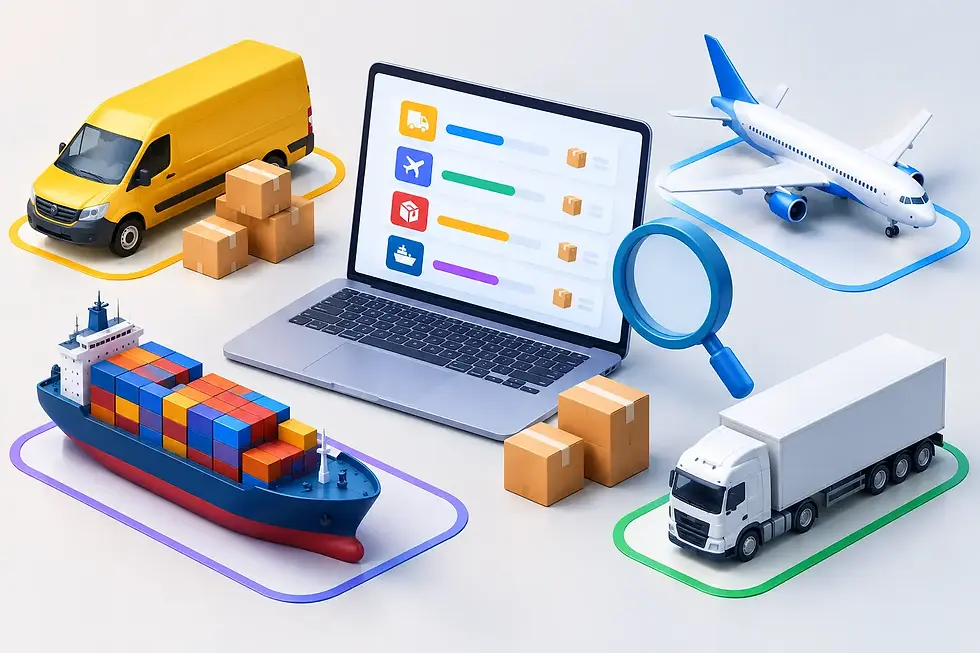
It's vital to distinguish between standard shipping software and freight management. While shipping tools focus on individual parcels, a true freight platform manages large-scale air, sea, and road freight. This includes everything from Less-than-Container Load (LCL) sea shipments to heavy road haulage. It provides the framework to quote, book, and track these high-value shipments without needing a massive logistics department.
The Three Pillars of Modern Freight Tech
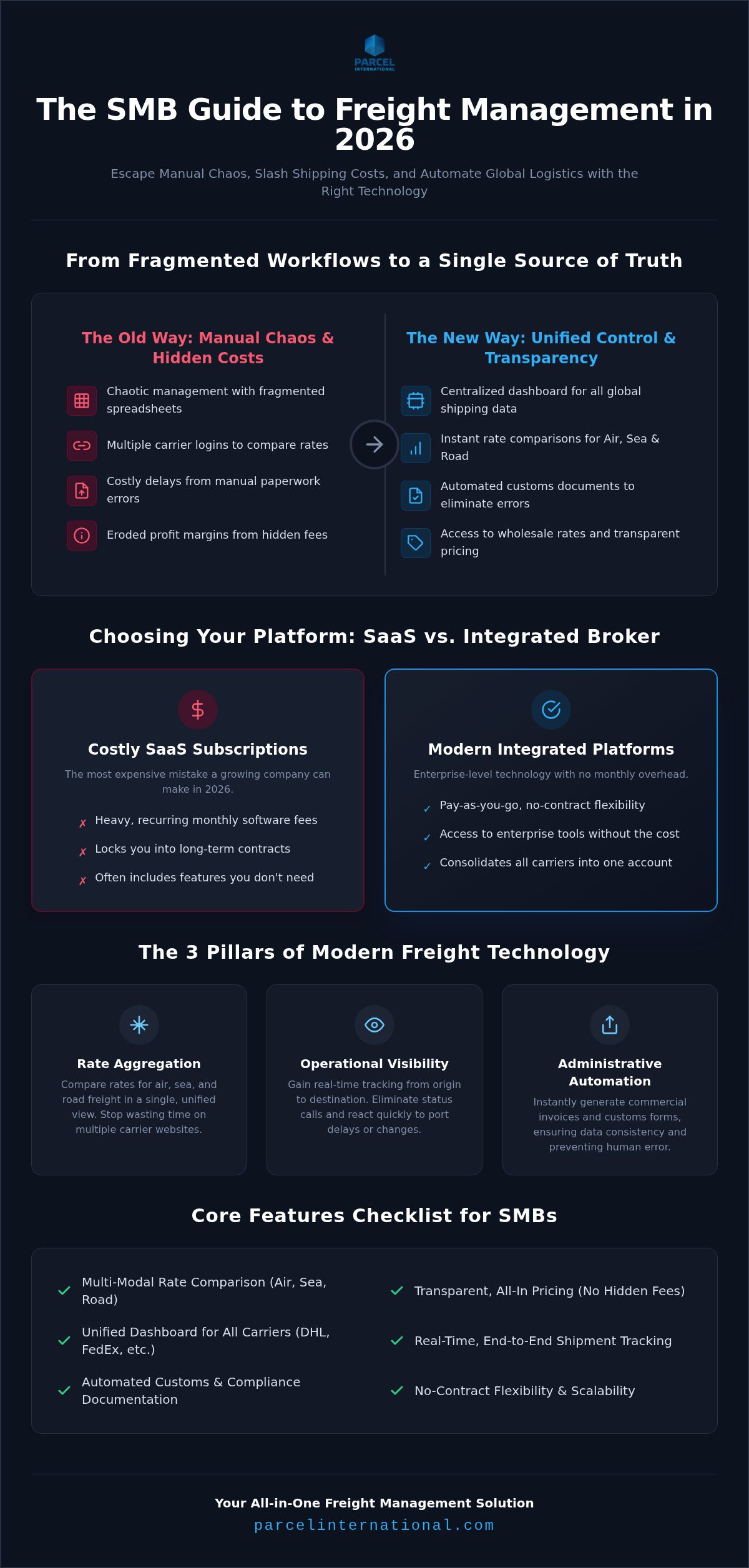
A reliable freight platform stands on three core capabilities that simplify global trade. First is rate aggregation. Instead of visiting ten different carrier websites, you compare rates for air, sea, and road freight in a single view. Second is operational visibility. You get real-time tracking from the point of origin to the final destination, which eliminates the need for constant status calls. Finally, administrative automation removes the burden of paperwork. The system generates commercial invoices and customs forms instantly, ensuring your data is consistent across every document.
Why SMBs Can No Longer Rely on Manual Logistics
Manual logistics is a significant liability for a growing company. Customs documentation is a minefield where a single typo on a Harmonized System (HS) code can lead to shipment seizures or expensive storage fees. These errors often stem from "human error" during manual data entry between different systems. Fragmented workflows also lead to missed delivery deadlines because tracking information isn't centralized. When your data is scattered across emails and paper folders, you lose the ability to react quickly to port delays or carrier changes. Perhaps most importantly, manual processes hide the true cost of shipping. Without a platform to provide real-time transparency, you're likely paying retail rates rather than accessing the wholesale pricing available through integrated digital intermediaries.
Key Features to Look for in an SMB Freight Platform
Selecting the right freight management software for small business requires looking past basic tracking. You need a platform that acts as a transparent intermediary, stripping away the complexity of global trade. High-performance software provides real-time rate comparisons across Air, Sea, and Road freight in a single view. This visibility is a significant competitive advantage for small businesses, allowing you to choose between speed and cost without visiting multiple carrier portals. By integrating partners like DHL, FedEx, and UPS into one dashboard, you eliminate the friction of fragmented workflows and gain the relief of a unified logistics strategy.
Transparent pricing is another non-negotiable feature. In a market where the national average diesel price reached $5.454 per gallon in August 2026, fuel surcharges and hidden "broker fees" can quickly erode your margins. Your software must provide all-in rates upfront. This radical transparency ensures you know your exact landed costs before booking, which is essential for maintaining healthy profit levels in a volatile economy. If you are ready to simplify your operations, exploring a unified freight dashboard is the first step toward total logistics control.
Automated Customs and Compliance
Border delays are frequently the result of manual paperwork errors. To prevent these bottlenecks, your software must generate commercial invoices and customs forms automatically based on your shipment data. This automation ensures consistency across every document and significantly reduces the risk of unexpected duties or tax surprises. For a deeper understanding of these requirements, see our guide on international shipping customs documentation. Reliable freight management software for small business handles these administrative burdens for you, providing the peace of mind that your cargo won't be held up by a simple clerical mistake.
Multi-Modal Flexibility
Your business needs to scale, and your software must scale with it. Effective platforms allow you to manage a single express parcel and a full sea container in the same interface. This multi-modal flexibility is essential for companies targeting diverse global markets. You might utilize Road Freight for distribution across Europe while relying on Air Freight for urgent stock replenishments from international suppliers. Having these options in one place simplifies your decision-making process. It allows you to move from small-scale personal needs to large-scale commercial projects without switching platforms or renegotiating contracts.
SaaS vs. Integrated Broker Platforms: Making the Right Choice
Choosing the right freight management software for small business often comes down to a fundamental question: do you pay for the tool, or do you pay for the shipment? Standard Software as a Service (SaaS) models provide high-end features but often demand a significant monthly overhead. For a growing company with fluctuating shipping volumes, this fixed cost creates a financial drain during slower months. In contrast, integrated broker platforms provide enterprise-grade technology as an inclusive part of the shipping service. This zero-subscription model is gaining massive traction in 2026 because it aligns your costs directly with your business activity.
Evaluating the Total Cost of Ownership (TCO) for your logistics tech requires looking beyond the sticker price. You must account for implementation time, training costs, and the potential for "feature bloat" where you pay for tools you don't yet need. A transparent intermediary platform removes these barriers, ensuring your technology investment never outpaces your actual shipping requirements. It's about finding a stable bridge that connects your business to global markets without the weight of unnecessary contracts.
The Problem with Monthly Subscriptions
Monthly subscriptions often force you to pay for advanced modules that your small business might not use for years. These platforms frequently create a "lock-in" effect; the complexity of the implementation makes it difficult to switch providers as your needs evolve. Flexibility is a vital competitive advantage for growing exporters. You don't want to be tied to a rigid contract that doesn't account for seasonal shifts or sudden changes in global trade routes. When you aren't shipping, you shouldn't be paying for the privilege of having an account.
The Broker-Platform Advantage
An integrated broker platform serves as a reliable ally by aggregating the volume of thousands of small businesses. This allows you to access wholesale rates from major carriers like DHL, FedEx, and UPS without needing to meet high-volume commitments on your own. Unlike SaaS help desks that only troubleshoot software bugs, these platforms offer professional support for the actual logistics process. If a shipment is delayed at a port, you talk to a logistics expert who understands the physical movement of goods, not just a software technician. To see how these models impact your bottom line, review our guide on international shipping for ecommerce for specific cost-saving strategies.
How to Implement Freight Software Without the Headache
Implementing freight management software for small business shouldn't be a months-long ordeal that halts your operations. It's a strategic shift designed to provide relief from administrative friction. Success starts with a structured transition that replaces guesswork with data-driven decisions. Follow these four steps to move from fragmented spreadsheets to a singular, efficient dashboard.
First, audit your current shipping volume and primary destinations to identify your most frequent lanes. Second, consolidate your various carrier accounts into a single platform to gain a unified view of your logistics. Third, automate your documentation workflow to ensure every customs form is accurate and compliant. Finally, train your team on the centralized dashboard so they can track shipments in real-time without switching between multiple browser tabs.
Auditing Your Logistics Needs
Before you book your next shipment, take a hard look at where your goods are going. Identifying your most frequent shipping lanes allows you to negotiate better terms or choose the right mode of transport. You must determine if a specific order requires the speed of Air Freight or if you can benefit from the significant savings of Sea Freight. Understanding what is a freight forwarder is essential here; they act as the stable bridge between you and the carriers, helping you navigate these choices. This audit helps you strip away the typical anxieties of complex global logistics by aligning your tech with your actual business needs.
Streamlining the Booking Process
Efficiency in 2026 relies on removing repetitive tasks. Use a shipping calculator to get instant estimates and compare costs across different transport modes. To save even more time, set up "default" package sizes and weights for your standard products. This allows for "one-click" documentation generation on repeat shipments, ensuring consistency and speed. When your team doesn't have to re-enter data for every pallet, they can focus on high-level growth rather than clerical entry. There are no fees or restrictions for setting up these time-saving defaults.
With spot rates for dry vans averaging $3.34 per mile and reefers at $3.76 as of August 2026, every minute saved in the booking process protects your bottom line. Transitioning to a professional platform removes the barriers of hidden costs and procedural friction. If you're ready to eliminate manual logistics and start saving, register for a free account to access our unified freight dashboard today.
Parcel International: Your All-in-One Freight Management Solution
Parcel International serves as the stable intermediary that turns chaotic global trade into an orderly, predictable process. Our freight management software for small business is built on a philosophy of radical transparency. We believe you shouldn't pay for technology you aren't using. That's why we've removed traditional barriers like subscription fees and volume minimums. You gain a unified platform for Express Shipping, Sea Freight, Air Freight, and Road Freight while only paying for the shipments you actually book. It's the ultimate tool for companies that value agility and cost control.
By centralizing your logistics in one dashboard, you eliminate the friction of hidden surcharges. You can compare real-time rates from major global carriers in seconds. This direct access ensures you always secure the most efficient route for your cargo. Beyond the technology, we provide expert customs support to handle complex international logistics. We generate your paperwork automatically, ensuring your business stays compliant and your goods stay on schedule. This is the freight management software for small business owners have been waiting for to simplify their global growth.
Why 20,000+ Businesses Trust Our Platform
We take an "optimizer" approach to logistics. We take the fragmented, multi-platform workflows that cause so much anxiety and replace them with a singular, unified solution. Our users access the same high-level technology as enterprise logistics departments without the enterprise price tag. Since 2007, we've focused on building a network that covers over 220 countries through partnerships with industry leaders like DHL, FedEx, and UPS. Our commitment to security and punctuality means you can trust us with your most critical shipments. There are no hidden costs or procedural hurdles here; just straightforward, reliable service.
Start Shipping Smarter Today
Bridging the gap between small business agility and global reach has never been easier. You don't need a massive team to manage international trade when you have the right partner. Creating a free account takes less than a minute, and you can get your first quote immediately. Experience the relief of having a single source of truth for all your shipping data. Take the first step toward a more efficient supply chain and Register for free and optimize your freight management today.
Future-Proof Your Global Logistics Strategy
The landscape of international trade is evolving rapidly, and staying competitive requires more than just moving goods. It demands a shift from fragmented, manual workflows to a singular source of truth. By choosing an integrated platform, you gain the relief of automated customs documentation and the flexibility of a zero-subscription model. Modern freight management software for small business provides the professional tools you need to scale without the burden of fixed monthly overhead or complex software lock-ins.
You don't have to navigate high-stakes logistics alone. With direct access to DHL, FedEx, and UPS rates, you can compare and book shipments with radical transparency. Stop losing time to paperwork errors and hidden broker fees. Instead, focus on your growth while our platform handles the administrative heavy lifting. It's time to bridge the gap between your local operations and global reach. Streamline your logistics and get instant freight quotes now to experience the efficiency of a unified dashboard with no subscription fees required. Your business is ready for the world; we're here to help you get there reliably.
Frequently Asked Questions
What is the best freight management software for a very small business?
The best freight management software for small business is a platform that provides enterprise-level tools without a monthly subscription. Very small businesses benefit from integrated broker platforms because they offer instant access to wholesale rates from major carriers like DHL and FedEx. This model ensures you only pay for what you ship. It removes the financial barrier of entry, allowing you to scale your global reach without any upfront investment.
Do I need to pay a monthly fee for freight management software?
You don't have to pay a monthly fee if you choose an integrated broker platform. While some SaaS providers charge high subscription costs, platforms like Parcel International operate on a transaction-based model. This means the technology is provided as part of the shipping service. You get the relief of a professional dashboard and real-time rate comparisons without the burden of a recurring overhead that eats into your profit margins.
Can freight software help with international customs documentation?
Modern freight software is specifically designed to handle international customs documentation. It automatically generates commercial invoices and customs forms based on the data you enter during the booking process. This automation significantly reduces the risk of human error, which is a common cause of border delays. By ensuring your paperwork is consistent and compliant, the software provides a stable bridge through complex global trade regulations.
What is the difference between shipping software and freight management software?
The primary difference lies in the scale and mode of transport. Shipping software typically focuses on individual express parcels and last-mile delivery. In contrast, freight management software for small business handles larger cargo, such as pallets and full containers. It manages multi-modal logistics across Air, Sea, and Road freight. This allows you to centralize all your shipping needs, from a single urgent document to a massive sea freight project.
Is it possible to integrate my existing DHL or UPS account into a freight platform?
Many platforms allow you to consolidate your existing carrier accounts into a single dashboard. This centralization provides a unified view of your logistics and simplifies tracking across multiple providers like UPS or FedEx. You'll often find that the platform's own wholesale rates are more competitive than individual small business accounts. Consolidating your accounts helps remove fragmented workflows and gives you a single source of truth for all your shipping data.
How much can a small business save by using freight management tech?
Small businesses save money by eliminating the invisible costs of manual logistics. By comparing real-time rates across multiple carriers, you can select the most cost-effective route for every shipment. Additionally, automating administrative tasks reduces the time your team spends on paperwork. Preventing a single customs delay can save thousands in storage fees. These efficiencies allow you to reinvest your resources into scaling your core business operations instead of managing spreadsheets.
Does freight management software handle Sea and Air freight or just parcels?
Comprehensive freight management platforms handle Express, Sea, Air, and Road freight. This multi-modal flexibility is essential for businesses that need to scale from sending small samples to shipping full containers. You can manage urgent air shipments and cost-effective sea freight in the same interface. This ensures you always have the right transport mode available for your specific destination, whether you're shipping across Europe or to the other side of the world.
How long does it take to set up a freight management platform?
Setting up a modern freight management platform takes only a few minutes. You can register for a free account and receive your first quote in seconds. There's no long implementation process or complex software installation required. Once your account is active, you can immediately start comparing rates and booking shipments. This speed allows you to respond quickly to market changes and client demands without any procedural friction or technical delays.