
International Shipping Customs Documentation: The Complete 2026 Guide
The era of easy, duty-free international shipping ended when the US eliminated the $800 de minimis exemption and the EU introduced its flat-rate duty on all low-value parcels. If you aren't prepared for these shifts, your shipments are likely facing unexpected seizures or expensive delays. Managing international shipping customs documentation shouldn't feel like a high-stakes guessing game where one wrong HS code leads to a $10,000 penalty. You've probably felt the frustration of fragmented paperwork and the anxiety of wondering if your cargo will actually clear the border. It's a common pain, but it's one we can solve with clarity and precision.
We'll help you master these complexities by transforming chaotic paperwork into an orderly, compliant strategy. This guide provides a clear roadmap of the forms required for 2026, including the new ICS2 messaging formats and updated HS codes. You'll learn how to accurately calculate duties to avoid hidden costs and discover how to automate the entire process. By the end of this article, you'll have the tools to move your goods across borders without the typical procedural friction or fear of delays.
Key Takeaways
Understand why customs documents act as a legal passport for your cargo, ensuring smooth transit between national jurisdictions.
Identify the "Big Three" essential forms required for every cross-border shipment to prevent unexpected package seizures.
Decode the Harmonized System (HS) to accurately classify your goods and calculate duties using universal trade logic.
Follow a strategic checklist to ensure your international shipping customs documentation meets specific local language and restricted item requirements.
Discover how to automate form generation to transform the complexity of 220 countries into a single, orderly workflow.
Table of Contents
The Role of International Shipping Customs Documentation in 2026
Think of your paperwork as the legal bridge between national jurisdictions. Without it, your goods are effectively stranded in no-man's land. In 2026, international shipping customs documentation functions as a digital passport that tells authorities exactly what is inside a box, where it originated, and how much tax is owed. This data determines the safety and taxability of every item crossing a border. It's the primary mechanism for maintaining security while ensuring the global flow of commerce remains uninterrupted.
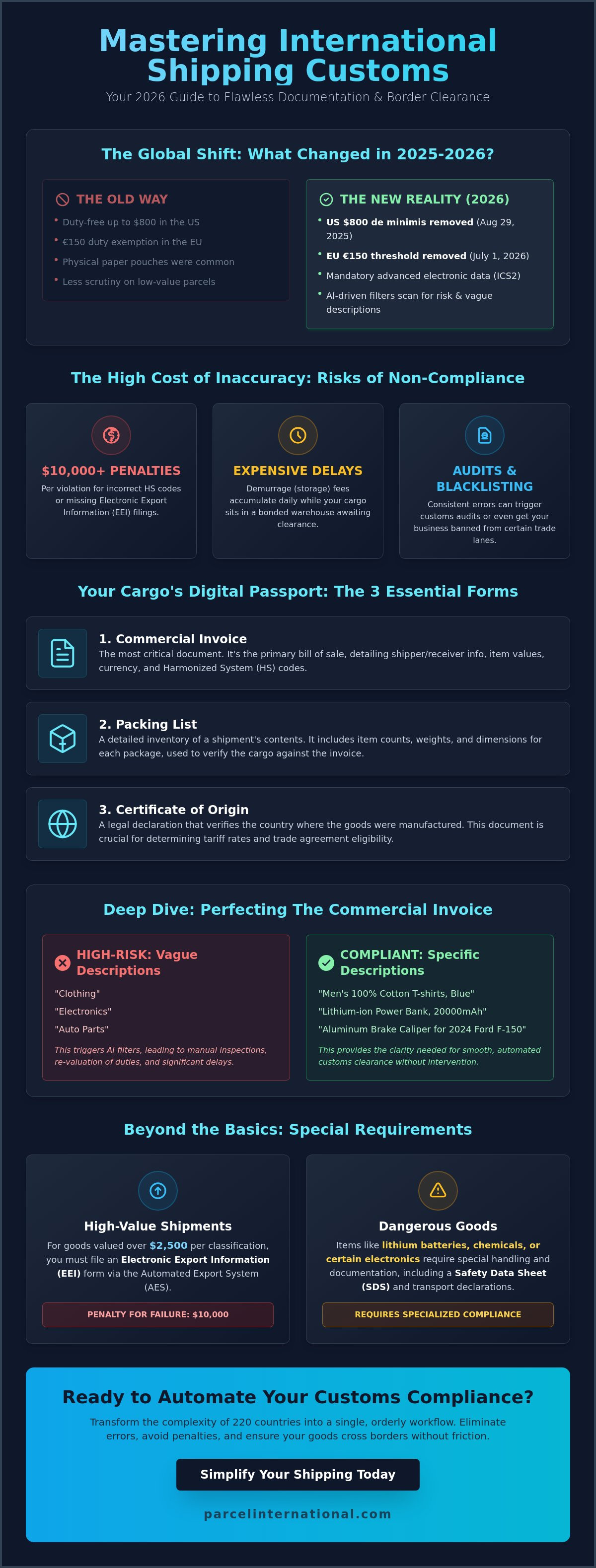
The global shipping environment has transitioned from physical pouches to mandatory digital data transmissions. Systems like the EU's Import Control System 2 (ICS2) now require advanced electronic information before a package even leaves its country of origin. The primary goal is straightforward. You must provide United States customs and global authorities with transparent, granular data. When you submit a Customs declaration, you're entering a high-stakes data-entry process where accuracy is the only currency that matters. Authorities now use AI-driven filters to scan for risks, making vague descriptions a liability you can't afford.
Why Documentation Accuracy is Non-Negotiable
Accuracy isn't just a best practice; it's a financial shield. A single typo in an HS code or a vague item description can trigger expensive storage fees, known as demurrage, while your cargo sits in a bonded warehouse. Even worse, consistent errors can lead to customs audits or the permanent blacklisting of your business from certain trade lanes. There is a profound sense of relief that comes with knowing your international parcel shipping is legally sound. You eliminate the friction of hidden costs and ensure your reputation remains intact with global regulators.
The Impact of Import Duty Policy Changes
The landscape changed significantly between late 2025 and mid-2026. The United States removed its $800 de minimis duty-free exemption on August 29, 2025. The EU followed suit by phasing out its €150 threshold on July 1, 2026. These changes mean that almost every shipment, regardless of its low value, is now subject to formal entry and taxes. 2026 regulations require more granular item descriptions than previous years to facilitate these new tax calculations. The shift from physical paper pouches to purely electronic data transmissions means you must be precise. Every semiconductor, solar component, or consumer good must be perfectly categorized to clear the border without manual intervention.
The Essential Forms for Cross-Border Shipments
Your shipment relies on the "Big Three" forms to clear borders without friction. These consist of the Commercial Invoice, the Packing List, and the Certificate of Origin. While B2B commercial shipments require strict compliance for tax and trade purposes, personal gifts or samples still need transparent documentation to avoid being flagged as suspicious. If you're moving high-value goods valued over $2,500 per Schedule B classification, you must file Electronic Export Information (EEI) through the Automated Export System (AES). Missing this step can lead to penalties reaching $10,000 per violation.
Specialized cargo requires additional layers of scrutiny. "Dangerous" goods, such as lithium batteries, chemicals, or certain electronics, must be accompanied by specific safety data sheets (SDS) and transport declarations. Understanding these Common Export Documents is the first step toward moving your cargo from a chaotic warehouse to its final destination. Precise paperwork acts as a shield against the hidden costs of delays and manual inspections.
Mastering the Commercial Invoice
The commercial invoice is the most critical part of your international shipping customs documentation. It acts as the primary bill of sale and must include full contact details for both the shipper and the consignee, including tax ID numbers. Vague descriptions are a major red flag for modern AI-driven customs filters. Don't just write "Clothing." Instead, use specific language like "Men’s 100% Cotton T-shirts." You must also explicitly state the currency and unit price. If the valuation is unclear, customs officers may assign their own value, which often results in significantly higher duties than necessary.
Packing Lists and Pro Forma Invoices
Use a Pro Forma invoice for samples, gifts, or shipments not intended for sale. It looks like a commercial invoice but should clearly state "not for resale." The packing list serves a different purpose; it's the primary tool used by customs officers during physical inspections. Ensure the weight and dimensions on the list match your shipping label exactly. Discrepancies here often lead to your package being pulled for a manual exam, which adds days to your delivery timeline.
Certificates of Origin (CO) and Trade Agreements
A Certificate of Origin can drastically reduce or eliminate import duties under specific trade deals. Preferential COs are used when a trade agreement applies, allowing for lower tax rates. Non-preferential COs simply state where the goods were manufactured. While a CO isn't always mandatory, it's a strategic cost-saving option that makes your products more competitive in foreign markets. If you want to simplify this process, our Customs Support platform can help you identify which trade agreements apply to your specific route.
Understanding HS Codes and Duty Valuation Logic
The Harmonized System (HS) codes act as the universal language for global trade. Every product, from a basic cotton shirt to a complex semiconductor, has a specific numerical identifier that tells customs exactly what's in the box. The first six digits are standardized globally, ensuring a baseline level of understanding between any two customs authorities. However, subsequent digits are country-specific. These additional numbers allow nations to apply unique tariffs or trade restrictions. Accurate classification in your international shipping customs documentation is the only way to ensure you pay the correct amount of tax and avoid costly seizures.
Successful shippers focus on the "Landed Cost" rather than just the sale price. This figure is the total sum of the product price, shipping fees, duties, and taxes. You must also decide on the best Incoterm for your needs. Under DDP (Delivered Duty Paid), the shipper handles all costs, including taxes. This creates a frictionless experience for the buyer. Conversely, under DAP (Delivered at Place), the recipient pays the duties upon arrival. This often leads to "delivery shock" and rejected packages if the customer isn't prepared for the bill. Choosing DDP is often the best way to maintain a professional, reliable brand image.
How to Classify Your Goods Correctly
Misclassification to save money is illegal and will eventually trigger a customs audit. However, legal "optimization" is a strategic move. This involves finding the most accurate code that reflects your product's specific materials or functions. As of January 1, 2026, the World Customs Organization (WCO) updated the HS codes with a heavy focus on emerging technologies and sustainable products. Many major trade lanes now require 8 to 10 digit codes for precise tracking. If you're looking for small business shipping solutions, use digital look-up tools to verify your codes before every shipment. Don't rely on outdated lists, as 2026 standards are significantly more granular than previous years.
Calculating Duties and Taxes
Most customs regimes use "Ad Valorem" duties, which are calculated as a percentage of the shipment's total value. In regions like the EU, Value Added Tax (VAT) is applied on top of the customs value, compounding the final cost. Consider a practical example: shipping a $500 electronics item from the US to Rotterdam. If the duty rate is 2% and the Dutch VAT is 21%, you aren't just paying $10 in duty. You're paying the duty first, then calculating the 21% VAT on the combined value of the item, shipping, and duty. This results in a total landed cost much higher than the original $500. Transparency in your international shipping customs documentation ensures these calculations are done correctly the first time, preventing your goods from being held for valuation disputes.
Strategic Checklist for Error-Free Customs Clearance
Precision at the final stage prevents chaos at the border. Before your goods leave the warehouse, you must verify the restricted and prohibited items list for the specific destination country. Regulations vary wildly; what's legal in the US might require special permits in the EU or Asia. You also need to ensure all descriptions are in the required language. This usually means English, but some regions now mandate a local language translation on the commercial invoice for faster processing. Check that your Incoterms are clearly marked. Whether you've chosen DDP or DAP determines who pays the duties, and customs officers need this information visible to avoid billing errors.
Accurately checking the "Reason for Export" is another critical step. Whether it's a Sale, Repair, or Gift, this designation changes how authorities view the shipment's value and taxability. Finally, perform a comprehensive audit of your international shipping customs documentation. Do the invoice, packing list, and shipping label all show the same weight? Discrepancies as small as a few hundred grams can trigger a manual inspection, adding days to your transit time. If you want to eliminate these manual checks, you can get started with our automated customs platform to ensure every field is perfectly aligned.
Digital Submission vs. Physical Attachments
The global shipping industry is moving toward "Paperless Trade." You should use digital submissions whenever possible to reduce the risk of documents being lost or damaged. When physical copies are required, follow the "Clear Pouch" rule. Place all forms in a transparent, resealable pouch on the outside of the box so officers can access them without opening the package. Keep digital copies of all your records for 5 to 7 years. This is a standard compliance requirement for most tax authorities and protects you during future audits.
Avoiding Common Customs Delays
Don't fall into the "Vague Description" trap. Writing "Parts" or "Electronics" on your forms is a guaranteed way to get your package flagged by modern AI filters. Be specific. Use descriptions like "Stainless Steel Hydraulic Valves" instead. Additionally, never omit the recipient's phone number. Customs authorities often need to contact the consignee to collect taxes or clarify delivery details. If your postnl international or express parcel gets stuck, having a correct phone number on the international shipping customs documentation is often the only way to resolve the issue quickly. Without it, the package will likely be returned at your expense.
Simplifying Customs Documentation with Parcel International
Managing global trade shouldn't feel like a full-time administrative burden. We've built our platform to act as an optimizer, taking the chaotic requirements of over 220 countries and turning them into a single, orderly workflow. Instead of navigating multiple carrier portals, you can view options from DHL, FedEx, and UPS within one unified dashboard. This centralized approach ensures your international shipping customs documentation remains consistent across every carrier you use. We believe in radical transparency. This means you won't deal with hidden fees, subscription requirements, or surprise charges when it comes to your paperwork.
Our platform is designed for speed and reliability. By removing traditional barriers like volume minimums, we make professional-grade logistics accessible to everyone. Whether you're a small business or a large commercial enterprise, the goal is the same: to move your goods from inquiry to action as quickly as possible. We act as your stable intermediary, bridging the gap between your warehouse and global customs authorities with precise, automated data.
Automated Generation of Commercial Invoices
Manual entry is the primary cause of friction at the border. When you book a shipment through our dashboard, the platform pulls data directly from your booking to populate legal forms instantly. This process significantly reduces the manual entry errors that lead to a vast majority of customs delays. By integrating with international trade compliance software, our system performs real-time validation on your data. It checks for missing tax IDs, vague item descriptions, and incorrect HS codes before the label is even printed. This proactive verification ensures your international shipping customs documentation is audit-ready every time.
Professional Support for Complex Logistics
Standard parcel forms aren't always enough for high-stakes or specialized projects. If you're moving heavy cargo via sea, air, or road freight, our logistics experts provide the specialized support you need to navigate complex regulations. There is immense relief in having a dedicated partner who understands the nuances of global delivery and the specific requirements of 2026 trade laws. We take the anxiety out of the process by providing a singular solution for all your shipping needs. Stop guessing and start shipping with confidence. Get a real-time international shipping quote and document preview today to see how we simplify your global logistics.
Master Your Global Trade Strategy
The 2026 shipping landscape demands absolute precision. You've seen how the elimination of duty-free thresholds and the rise of digital-first systems like ICS2 have transformed the industry. Mastering your international shipping customs documentation is no longer just a legal requirement; it's a strategic advantage that prevents costly seizures and delays. By focusing on granular HS code classification and utilizing the right Incoterms, you move from reactive troubleshooting to proactive logistics management. This shift provides the relief of knowing your supply chain is secure and compliant.
You don't have to navigate these complexities alone. Simplify your global logistics and automate customs forms with Parcel International. Our platform provides automated documentation for over 220 countries and offers wholesale rates from DHL, FedEx, and UPS. We operate with radical transparency, which means you'll never face subscription fees or hidden volume requirements. We take the chaos of fragmented workflows and make them orderly, serving as a stable intermediary in a complex market.
Take control of your supply chain today. With the right tools and a commitment to data accuracy, your goods will clear borders faster and more reliably. Your global success is within reach.
Frequently Asked Questions
Do I need a customs form for every country I ship to?
Yes, you generally need a customs form for every shipment that crosses a national border. While some trade zones like the European Union allow free movement between member states, 2026 regulations like ICS2 require advanced electronic data for almost all goods entering the bloc from outside. Always assume a form is required to avoid your package being rejected at the point of origin.
What happens if my customs documentation is incorrect?
Incorrect documentation leads to immediate delays, expensive storage fees, or total cargo seizure. If you make errors in your international shipping customs documentation, you also risk fines of up to $10,000 for specific filing violations. Consistent mistakes can even lead to your business being blacklisted by global authorities, so accuracy is your best financial protection.
How do I find the correct HS code for my product in 2026?
Use the official World Customs Organization (WCO) look-up tools or an integrated shipping platform to find your code. The 2026 updates specifically impacted products related to semiconductors, solar technology, and electric vehicles. Always verify the first six digits are globally recognized before adding the country-specific suffix required by the destination nation to ensure your classification is precise.
What is the difference between a Commercial Invoice and a Pro Forma Invoice?
Use a Commercial Invoice for goods that are being sold to a customer. It serves as both a bill of sale and a primary tax document. In contrast, a Pro Forma invoice is for shipments with no commercial value, such as samples, gifts, or items returned for repair. Both must be accurate, but the Pro Forma must clearly state "not for resale" to avoid being taxed as a standard sale.
Is there a way to avoid paying import duties on international shipments?
You cannot legally avoid duties now that the US and EU have eliminated their low-value duty-free thresholds. However, you can reduce costs by using a Certificate of Origin to leverage specific free trade agreements. This doesn't bypass the system; it simply applies a lower, legal tax rate based on where your goods were manufactured, making your products more competitive.
Do documents (paper only) require customs forms?
Purely paper documents, such as business letters or contracts, typically don't require customs forms. However, if your "documents" include heavy manuals, books, or any item with a resale value, you must treat them as a commodity. Always check the specific weight and value limits for the destination country to prevent a simple letter from being held for inspection.
How long does it typically take for a parcel to clear customs?
Perfect documentation allows most parcels to clear customs within 24 to 72 hours. If your international shipping customs documentation contains errors or vague descriptions, this process can stretch into weeks. Modern AI filters scan for risks instantly. Any data discrepancy will pull your package out of the automated lane for a slow, manual inspection that adds days to your timeline.
Can I fill out customs forms digitally for all carriers?
You can fill out forms digitally for all major global carriers like DHL, FedEx, and UPS. Using "Paperless Trade" is highly recommended because it reduces the risk of physical documents being lost or damaged during transit. Most modern shipping dashboards will automatically transmit this electronic data directly to customs authorities as soon as you create your shipping label.


