
How to Master Parcel Delivery Abroad: A Step-by-Step 2026 Guide
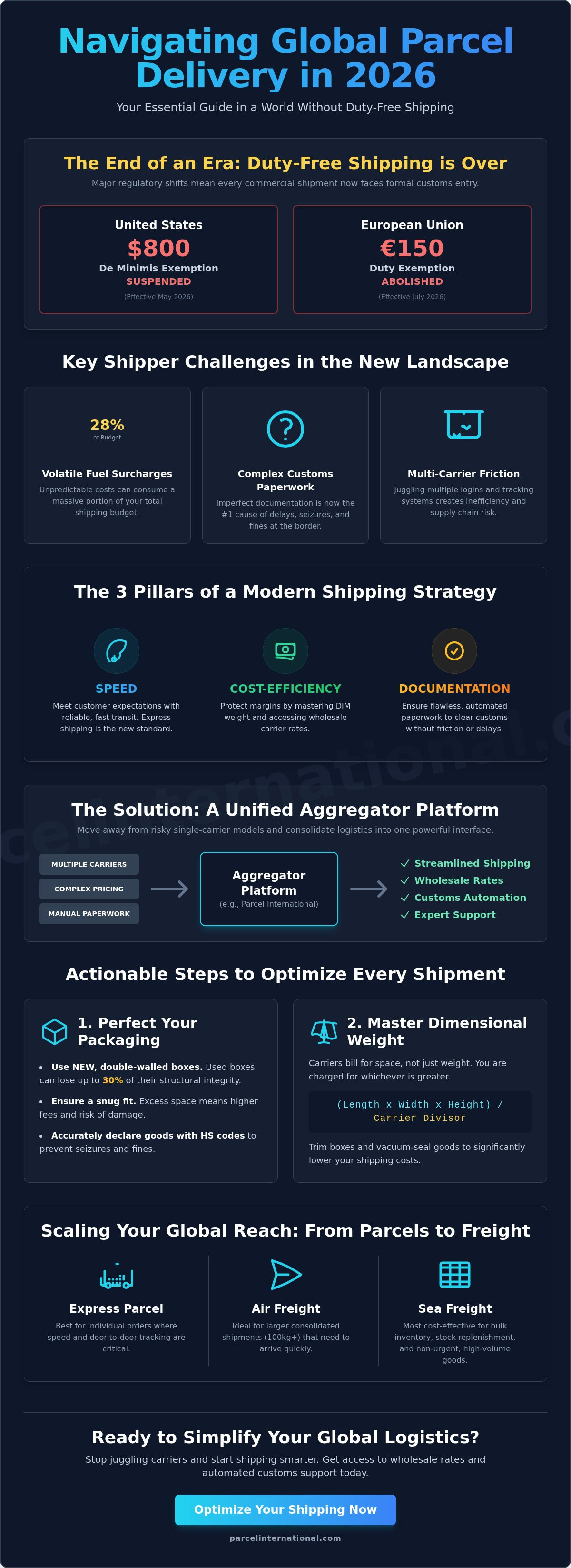
Did you know that the era of duty-free cross-border shipping has officially ended? As of May 2026, the $800 US de minimis exemption remains suspended, and the EU is preparing to abolish its €150 threshold this July. These regulatory shifts mean every commercial shipment now faces formal entry requirements, making parcel delivery abroad more complex and costly than ever before.
You're likely dealing with the daily frustration of opaque pricing and volatile fuel surcharges that can now consume 28% of your total shipping budget. It's difficult to maintain efficiency when you're forced to manage multiple carrier logins and navigate a maze of customs paperwork that often leads to avoidable delays. You need a process that works as hard as you do, without the hidden fees or procedural friction that slows down your growth.
This guide promises to simplify your global logistics by moving you toward a unified, automated strategy. You'll learn how to secure wholesale carrier rates and use automated customs forms to ensure your shipments clear borders without hesitation. We will outline the most effective ways to utilize Express Shipping, Sea Freight, and professional Customs Support to keep your business moving at full speed in this new regulatory landscape.
Key Takeaways
Navigate the 2026 regulatory landscape by prioritizing stricter compliance to ensure your shipments clear borders without friction.
Optimize your budget for parcel delivery abroad by mastering dimensional weight calculations and selecting the right balance between Express and Economy services.
Access wholesale rates and expert Customs Support through aggregator models that simplify multi-carrier management.
Prevent seizures and fines by accurately classifying goods with HS codes and perfecting your commercial documentation.
Recognize when to scale your operations from individual parcels to high-capacity Air or Sea Freight for maximum efficiency.
Table of Contents
Understanding the Landscape of Parcel Delivery Abroad in 2026
Successful parcel delivery abroad is a multi-stage logistical journey. It isn't just about moving a box from point A to point B; it's about managing a series of handoffs between carriers, customs officials, and regional networks. To understand how we reached this level of complexity, it helps to look at the history of parcel post. What began as a simple exchange between national postal services has transformed into a high-tech global industry that demands precision at every turn.
In 2026, global trade is defined by a paradox: transit times are faster than ever, but regulatory compliance is significantly stricter. The US suspension of the $800 de minimis exemption and the EU's abolition of the €150 duty exemption on July 1, 2026, have fundamentally changed the rules. Documentation is no longer a secondary task. It's the primary factor in determining your delivery speed. If your paperwork isn't perfect, your parcel won't move.
To master this environment, you must focus on the three pillars of successful delivery: speed, cost-efficiency, and documentation. Speed keeps your customers happy. Cost-efficiency protects your margins against rising fuel surcharges, which can now account for up to 28% of shipping totals. Documentation ensures your goods actually reach their destination. Balancing these requires a shift away from fragmented workflows toward a unified strategy.
Many businesses struggle with the friction of managing multiple carrier logins and manual tracking. This is where a logistics broker acts as an optimizer. By consolidating Express Shipping, Air Freight, and Sea Freight into a single interface, they strip away the typical anxieties of global logistics. They serve as a stable intermediary, providing the relief of a singular, transparent solution in a chaotic market.
The Evolution of Cross-Border Logistics
E-commerce has permanently shifted expectations. Door-to-door Express Shipping is now the business standard. Customers don't just want their items; they want to see every step of the journey. Transparency is the top priority for 2026. If a customer can't track a package in real-time, they lose trust in the brand. Businesses that provide clear, proactive data are the ones that thrive in the global marketplace.
Why Businesses are Moving Away from Single-Carrier Models
Relying on one carrier is a significant risk. If that carrier faces a strike, a system outage, or a regional delay, your entire supply chain stops. Carrier lock-in limits your flexibility and often leads to higher costs. Accessing multiple networks-including Road Freight for continental routes-ensures higher delivery success rates. For a deeper look at these diversified strategies, read our guide on international parcel shipping. You'll find that using a variety of carrier services is the best way to maintain parcel delivery abroad even during global disruptions.
Step-by-Step: Preparing Your Shipment for Global Transit
Preparing a package for parcel delivery abroad requires a technical approach to minimize costs and maximize security. In 2026, carriers have refined their automated sorting technology. This means every millimeter of your box is scanned and billed with extreme precision. If your preparation is sloppy, your margins will suffer. Start by selecting a container that fits your item snugly; excess space is an invitation for both transit damage and unnecessary fees. Use double-walled corrugated cardboard for any journey involving multiple hubs or long-haul transit. Used boxes often lose up to 30% of their structural integrity, so always opt for new materials to ensure your goods survive the "last mile" of the journey.
Mastering Dimensional Weight (DIM)
Carriers don't just care about how heavy your parcel is. They care about how much room it occupies in a cargo plane or shipping container. Dimensional weight is the industry standard for pricing based on space rather than mass. To calculate it, use this formula: (Length x Width x Height) / Carrier Divisor.
If your DIM weight is higher than the actual weight, you'll be billed for the higher value. To lower your costs, trim your boxes to size or use vacuum-sealing for soft goods. Small adjustments can result in significant savings when aggregated over hundreds of shipments. If you're unsure about how these rules apply to your specific items, our Customs Support team can help you audit your packaging strategy to find the most cost-effective solution.
Addressing and Labeling for 220+ Countries
International addressing is a common failure point. A "return to sender" error can double your shipping costs and ruin customer trust. Always include the recipient's local phone number and email address. In many regions, carriers won't attempt delivery without contacting the recipient first to confirm arrival times or tax payments. Standardize your formats for non-Western regions; some countries require the postal code before the city, while others place house numbers after the street name.
Verify every postal code against carrier databases before printing your labels. When applying the label, place it on a flat surface of the box. Avoid seams or corners where the barcode might wrap and become unreadable by scanners. Protecting the label with clear tape is wise, but never cover the barcode itself, as the glare can interfere with laser scanning. Before sealing the box, review the 2026 regulations for prohibited items. Restrictions on lithium batteries, pressurized canisters, and certain liquids have tightened significantly. You should also ensure your common export documents are securely attached in a clear pouch on the exterior of the parcel to prevent customs agents from having to open your packaging.
Comparing International Shipping Rates and Carrier Services
Choosing the right carrier for parcel delivery abroad is no longer a matter of brand loyalty. It's a strategic decision based on real-time data and regional performance. In 2026, major carriers like FedEx, UPS, and DHL have implemented average rate increases of 5.9%. While base rates are rising, the real volatility lies in surcharges. Fuel surcharges now account for 15% to 28% of total costs, and peak season or remote area fees can quickly erode your profits if they aren't calculated upfront. You must decide whether to prioritize speed with Express Shipping or opt for Economy services when transit time is less critical. For time-sensitive business contracts or high-value electronics, the reliability of a time-definite express service is often worth the premium.
Small businesses often feel forced into expensive retail rates because they lack the volume of global corporations. This is where the aggregator advantage changes the game. By using a logistics broker, you gain access to wholesale rates that are normally reserved for high-volume shippers. These platforms act as a stable intermediary, consolidating the buying power of thousands of users to drive down costs. Unlike traditional carrier contracts, these modern platforms often operate without subscription requirements or volume minimums. This egalitarian approach allows you to scale your parcel delivery abroad without being locked into a single, restrictive network.
Evaluating Carrier Strengths (DHL vs. UPS vs. FedEx)
Each carrier has a specific "home-field" advantage. DHL remains the dominant force in Europe and many emerging markets, offering extensive ground and air networks. FedEx maintains a superior infrastructure within the United States, while UPS provides highly integrated global logistics solutions. When comparing services, distinguish between "Time-Definite" (delivered by a specific hour) and "Day-Definite" (delivered by the end of a specific day). To see how these differences impact your bottom line, review our guide on international shipping rates for a detailed breakdown of current pricing frameworks.
How to Use a Shipping Rate Calculator Effectively
An accurate quote depends entirely on the quality of your data. You need exact dimensions, the weight after packaging, and precise postal codes for both the origin and destination. A single dashboard allows you to compare multiple quotes side-by-side, stripping away the anxiety of "what-if" pricing. Use these tools to identify the best fit for each specific parcel rather than relying on a one-size-fits-all approach. By viewing all available options in one place, you can spot regional carriers or postal-hybrid solutions that might offer significant savings for low-density items. This unified workflow ensures you never overpay for a label again.
Real-time tracking is the final, non-negotiable component of modern shipping. 2026 customers expect end-to-end visibility from the moment a label is created until the final signature is captured. Providing a single tracking number that works across different regional networks reduces customer service inquiries and builds long-term trust. It moves your operation from a fragmented, reactive model to a proactive, transparent logistics strategy.
Navigating Customs: Avoiding Delays and Hidden Fees
Customs clearance is the point where parcel delivery abroad often hits a wall. It's no longer enough to just ship a package; you must provide a perfect digital audit trail. The Commercial Invoice is the most important document in your shipment. It serves as the official declaration to border authorities about what's inside, why it's being sent, and what it's worth. In 2026, customs agents have zero tolerance for vague descriptions like "samples" or "merchandise." If your invoice lacks detail, your parcel will be flagged for inspection, leading to storage fees and delivery delays that ruin the customer experience.
Accuracy starts with HS Codes (Harmonized System). HS codes are the 6-to-10 digit standard for identifying goods for customs authorities. Using the wrong code isn't just a minor mistake; it's a compliance failure that can result in the seizure of your goods or heavy fines. Authorities use these codes to determine the exact duty and tax rates applicable to your shipment. By classifying your items correctly from the start, you ensure a smooth transition through international hubs and maintain the speed your business requires.
Automating Customs Documentation
Manual paperwork is a relic of the past that invites human error. Parcel International’s tools generate your required documentation automatically during the booking process. By pulling data directly from your order details, these systems ensure that value declarations and item descriptions remain consistent. This automation strips away the anxiety of "getting it wrong" and provides the relief of a unified, compliant workflow. If you want to eliminate the friction of manual filing, you can access our professional Customs Support to streamline every border crossing.
Managing Import Duties and Taxes
Understanding the financial landscape of global trade is vital for e-commerce growth. You must be aware of the "De Minimis" thresholds, which are the values below which no duties are charged. As of May 2026, these rules have shifted dramatically:
United States: The $800 de minimis exemption has been suspended since August 2025. All commercial shipments now require formal entry and duties.
European Union: The €150 customs duty exemption will be abolished on July 1, 2026. A temporary flat-rate duty of €3 per item will apply to low-value consignments starting then.
Canada: The threshold remains CAD $20 for duties and CAD $40 for taxes, though CUSMA shipments from the US or Mexico have a CAD $150 duty-free limit.
Australia: The threshold for imported goods is currently AUD $1,000.
You also need to choose between DDP (Delivered Duty Paid) and DAP (Delivered at Place). With DDP, you pay all taxes upfront, providing a seamless experience for your customer. With DAP, the recipient must pay before they can receive their package. Transparency regarding these "landed costs" is essential. Don't let a surprise tax bill at the doorstep damage your brand's reputation. Communicate potential costs clearly and use automated tools to calculate VAT and duties before you finalize any parcel delivery abroad.
Scaling Your Global Reach: From Parcels to Freight
As your business expands, the strategy that worked for individual parcel delivery abroad eventually hits a ceiling. Managing fifty separate boxes is rarely as efficient as shipping a single pallet. You've reached the tipping point when your total shipping volume exceeds 100 kilograms or when the sheer number of tracking numbers becomes unmanageable for your team. Shifting to freight isn't just about moving larger items; it's about optimizing your entire supply chain to reduce the cost per unit. This transition allows you to move from a reactive shipping model to a proactive logistics strategy.
A diversified strategy balances speed with your budget. Air Freight offers the velocity required for high-value inventory, while Sea Freight provides the lowest possible cost for bulk stock replenishment. For many businesses, the ideal solution is LCL (Less than Container Load). This consolidation strategy allows you to share container space with other shippers, paying only for the volume you use. It's a transparent way to access global markets without the expense of a full container. Using a single platform to manage both your small parcels and these larger logistics projects removes the friction of fragmented workflows and keeps your data in one place.
When to Choose Air or Sea Freight
The choice between air and sea depends on your inventory turnover. Air Freight typically reaches global destinations in 3 to 7 days, making it the standard for urgent replenishment. Sea Freight is a longer-term commitment, often taking 3 to 6 weeks, but it's the most cost-effective method for high-volume goods. For regional bulk movements within the continent, check international road freight rates Europe to compare land-based options. A broker simplifies this transition by helping you move from small boxes to palletized cargo without needing to learn an entirely new set of carrier rules.
Building a Long-Term Logistics Partnership
Expansion requires more than just software; it requires a dedicated support team that understands your specific business goals. Automated call centers and generic chatbots can't solve complex customs issues or redirect a freight shipment in mid-transit. A single point of contact provides the relief and stability needed during periods of rapid growth. You need a partner that acts as a stable intermediary, stripping away the procedural anxiety associated with parcel delivery abroad and large-scale freight operations. This egalitarian approach ensures that even small businesses can access the same level of professional Customs Support as global corporations.
Stop juggling multiple platforms and opaque pricing. Simplify your global logistics with Parcel International today and gain access to a unified solution for every stage of your growth journey.
Take Control of Your Global Logistics
The landscape of international shipping has shifted toward stricter compliance and higher precision. You've learned that mastering parcel delivery abroad in 2026 requires more than just picking a carrier; it requires a unified strategy that automates customs documentation and optimizes dimensional weight. By moving away from fragmented workflows, you eliminate the procedural friction that causes delays and hidden costs. This transition allows you to focus on your core business while your logistics operate with machine-like efficiency.
Whether you're shipping small boxes via Express Shipping or scaling up to Sea Freight, the right partnership provides the transparency you need to grow. You don't have to navigate these complexities alone. Access a stable intermediary that simplifies the process for both small businesses and large commercial projects. This egalitarian approach ensures you can compete on a global stage without the burden of subscription fees or volume minimums. Reliability is no longer a luxury; it's a standard you can expect for every shipment.
Compare rates and book your international shipment now to reach over 220 countries with ease. Benefit from wholesale rates from industry leaders like DHL, UPS, and FedEx, with automated customs documentation included at every step. It's time to transform your shipping from a source of anxiety into a competitive advantage. Your global expansion starts today.
Frequently Asked Questions
How do I calculate the cost of parcel delivery abroad?
Cost is determined by the greater of your parcel's actual or dimensional weight, combined with the destination zone. Surcharges for fuel, which can reach 28% of the total, and remote area fees are added to the base rate. Use an online calculator to input exact box measurements for an accurate quote. This ensures you avoid surprise bills and maintain transparent pricing for your business operations.
What is the cheapest way to send a parcel internationally in 2026?
Economy road freight or sea freight typically offers the lowest rates for non-urgent shipments. For smaller items, using a logistics aggregator provides access to wholesale rates from major carriers that are usually reserved for high-volume accounts. This model eliminates the need for expensive subscriptions while significantly lowering the cost of parcel delivery abroad. Always compare multiple carrier quotes to find the most efficient balance between price and transit time.
How long does express shipping usually take for international destinations?
Express shipping generally takes between 1 and 5 business days to reach most global destinations. Major hubs in Europe or North America often see deliveries within 24 to 48 hours, while more remote regions require additional transit time. Choosing a "Time-Definite" service provides a specific delivery window, which is essential for high-stakes business documents or high-value goods that demand punctuality and security.
What documents are required for shipping a parcel abroad?
You must provide a detailed commercial invoice and a clear shipping label for every international package. These documents act as the primary communication with customs officials regarding the value and nature of your goods. Depending on the destination and item type, you might also need a Certificate of Origin or specific export licenses. Filing these documents electronically during the booking process reduces the risk of physical paperwork becoming detached during transit.
Can I track a parcel sent abroad in real-time?
Yes, 2026 carrier networks provide end-to-end visibility for every stage of the journey. You'll receive a unique tracking number that allows you to monitor the parcel's progress from the initial pickup to the final signature. Using a unified dashboard simplifies this by showing all your shipments in one place, removing the need to check different carrier websites. This transparency builds trust with your recipients and allows for proactive management of any potential delays.
What happens if my international parcel is held at customs?
If a parcel is held, the customs authority or the carrier will notify the recipient to pay outstanding duties or provide missing information. This often happens due to incorrect HS codes or incomplete item descriptions on the commercial invoice. To resolve this, respond quickly with the requested documentation or proof of payment. Utilizing professional Customs Support can prevent these holds by ensuring all compliance requirements are met before the parcel leaves your facility.
Are there weight limits for international parcel services?
Standard parcel services typically have a weight limit of 30kg to 70kg per package. If your shipment exceeds these limits, it's usually classified as freight and requires palletization for safe handling. At this tipping point, you should transition to Air Freight or Sea Freight to maintain cost-efficiency and ensure the structural integrity of your goods. Freight services provide the specialized equipment needed to move heavy or oversized items across global networks.
How do I know which HS code to use for my products?
Identify your HS code by using official government classification tools or consulting with a logistics broker. These 6-to-10 digit codes are standardized globally to ensure customs agents can quickly identify the contents of your parcel delivery abroad. Accuracy is vital because an incorrect code can lead to overpayment of duties or the seizure of your shipment. If your product is complex, expert Customs Support can help you determine the correct classification to maintain compliance.


