
What is a Freight Forwarder? The Complete 2026 Business Guide to Global Logistics
If you think a freight forwarder is still just a middleman booking cargo space, your supply chain is likely operating with a 2019 mindset in a 2026 economy. With the International Monetary Fund projecting global trade growth at 3.1% this year, the competition for capacity is intensifying. You need a digital architect who can handle new IMO regulations regarding container loss reporting and mandatory electronic inclinometers while managing the volatility of global shipping routes.
It's natural to feel overwhelmed by the friction of customs paperwork or the sudden implementation of carrier surcharges. These administrative hurdles often lead to expensive delays and unnecessary stress. We'll show you how to master these complexities by understanding how a modern partner streamlines your supply chain and protects your margins. This guide provides a clear framework for choosing a reliable logistics ally, compares air versus sea freight efficiency, and outlines a path to significantly reduce your shipping administrative burden.
Key Takeaways
Understand that a modern freight forwarder acts as a digital architect, managing complex information flows to keep your supply chain moving efficiently.
Master the step-by-step logistics process, from initial export haulage to the critical documentation required for seamless customs clearance.
Distinguish between physical carriers and logistics intermediaries to ensure you choose a partner that offers the digital transparency your business deserves.
Learn how to vet a logistics partner’s global network and technical infrastructure to secure reliable shipping to over 220 countries.
Gain immediate access to wholesale rates and automated customs support without the burden of high-volume contracts or hidden subscription fees.
Table of Contents
Understanding the Freight Forwarder: Your Global Logistics Architect
Think of your supply chain as a complex orchestral performance. You don't expect the conductor to play the violin, but without them, the music falls apart. This is exactly how a freight forwarder operates. Technically, a forwarder is an intermediary that organizes the end-to-end transport of goods. For a comprehensive overview of freight forwarding, it's vital to recognize that they rarely own the ships or planes themselves. They are architects of information, not necessarily owners of hardware. They move the data, the documentation, and the legal clearances that allow your cargo to travel across borders.
In 2026, this role has shifted from manual phone calls to real-time digital orchestration. Businesses rely on this expertise for both international parcel shipping and heavy bulk freight to ensure nothing gets stuck at a border. By centralizing the flow of information, they turn a fragmented shipping process into a streamlined competitive advantage.
The Role of the Intermediary in Modern Trade
Forwarders bridge the gap between your business and massive global carriers. By consolidating volume, they access wholesale rates from providers like DHL, FedEx, and UPS that individual shippers simply can't reach. You'll often choose between asset-based providers, who own some equipment, and non-asset providers, who focus entirely on logistics management. Both act as your single point of contact. This setup strips away the friction of managing multiple carrier relationships simultaneously, providing you with a unified solution for air, sea, and road freight.
Why SMBs Need Forwarding Support
Moving from domestic sales to 220+ global territories is a high-stakes leap. Small and medium businesses often face crippling port storage fees or delivery delays due to minor paperwork errors. A reliable partner mitigates these risks by managing the customs support process and providing access to specialized transport like Less than Container Load (LCL). This allows you to ship smaller volumes without paying for an entire container. It keeps your cash flow healthy while you scale. Instead of losing sleep over hidden shipping costs or transport modes, you can focus on your core business growth while the freight forwarder handles the operational heavy lifting.
How Freight Forwarding Works: A Step-by-Step Breakdown
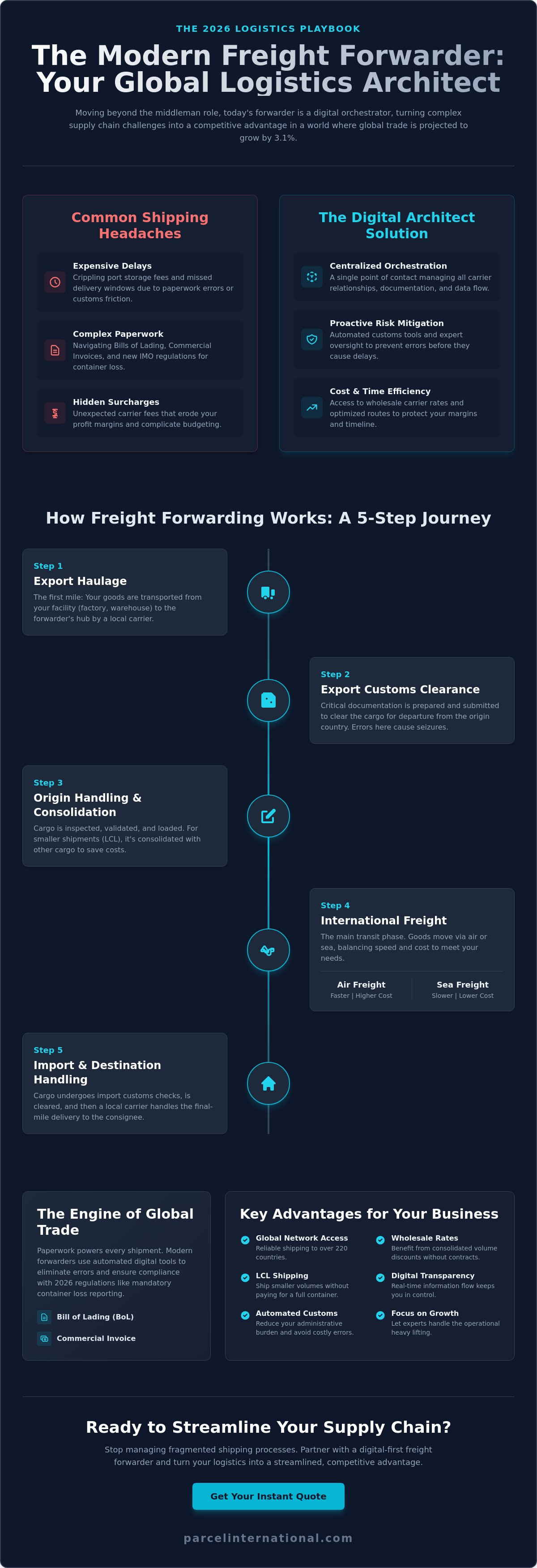
The journey of a global shipment is a multi-stage relay race. It requires precise timing and flawless handoffs between different entities. Understanding this sequence allows you to identify where delays typically occur and how a freight forwarder prevents them. The process follows five primary steps.
Export Haulage: This is the first mile. A local carrier moves your goods from your facility to the forwarder's warehouse or hub.
Export Customs Clearance: Your cargo must be legally cleared by the origin country. Mistakes here lead to immediate seizures or fines.
Origin Handling: Forwarders inspect the cargo, validate the packing list, and prepare it for loading.
International Freight: This is the transit phase. Your goods move via sea freight, air freight, or road freight depending on your budget and timeline.
Import Customs and Destination Handling: Once the cargo arrives, it undergoes a second customs check before a local carrier completes the final delivery to the consignee.
The Critical Documentation Phase
Paperwork is the engine of global trade. Without a correct Bill of Lading (BoL) and Commercial Invoice, your cargo stays at the port. In 2026, the industry has shifted toward automated customs tools to eliminate manual entry errors. You must also stay compliant with U.S. government requirements for freight forwarders to ensure your intermediary is licensed for these tasks. Modern systems now integrate new 2026 regulations, such as mandatory container loss reporting, directly into the digital filing process. If you want to skip the manual "customs headache," you can access integrated documentation tools that handle these requirements automatically.
Consolidation: The Key to Cost Savings
Small businesses often don't have enough cargo to fill a 40ft container. This is where consolidation becomes essential. A freight forwarder groups your shipment with others to fill a single container, a process known as Less than Container Load (LCL). This allows you to pay only for the space you use. If you have high-volume needs, Full Container Load (FCL) offers more security and faster transit. You must also weigh the trade-offs between air freight speed and sea freight economy. While air cargo capacity has fluctuated in 2026, it remains the standard for express shipping needs. Sea freight remains the most cost-effective choice for bulk inventory, even with the current volatility in ocean spot rates.
Freight Forwarder vs. Carrier vs. Broker: Knowing the Difference
Distinguishing between the various players in global logistics is essential for protecting your margins. While the terms are often used interchangeably, a freight forwarder, a carrier, and a broker each provide different levels of support and infrastructure. Choosing the wrong one can lead to rigid contracts or a lack of support when things go wrong at the port.
The carrier is the physical owner of the transport assets. Companies like Maersk, FedEx, or UPS own the ships, planes, and trucks that move your cargo. A traditional forwarder acts as the intermediary, managing the logistics and documentation on your behalf. They are often members of organizations like the International Federation of Freight Forwarders Associations (FIATA), which sets global standards for the industry. However, traditional models sometimes lack the transparent digital interface that modern businesses require.
The logistics broker or aggregator represents the 2026 evolution of this role. Instead of being locked into one carrier's schedule, an aggregator platform allows you to compare real-time rates across multiple providers. This model offers the most flexibility because it doesn't tether your business to a single carrier’s operational limits. It allows you to pivot instantly if one route becomes congested or expensive.
Direct Carriers: Pros and Cons
Contracting directly with a carrier makes sense if you're moving massive, consistent volumes every week. You might secure a dedicated account manager and stable pricing. But for most businesses, the downside is a complete lack of flexibility. If that specific carrier faces a strike, a vessel breakdown, or a route cancellation, you don't have an immediate alternative. Smaller shippers also tend to receive limited customer support compared to the personalized care a dedicated forwarder provides. You're often just a number in a vast corporate system.
The Rise of Digital Logistics Platforms
Digital tools are currently revolutionizing the industry. For example, international freight forwarding in Rotterdam now relies heavily on automated orchestration to manage one of the world's busiest ports. By using a digital dashboard, you can compare international shipping rates in seconds rather than waiting days for manual quotes. This approach eliminates traditional barriers like subscription fees and volume minimums. It levels the playing field, allowing growing businesses to access the same logistics power as global corporations without the overhead.
How to Choose a Freight Forwarding Partner in 2026
Selecting a logistics partner shouldn't feel like a gamble. In 2026, the criteria for a reliable freight forwarder have shifted from simple cost-cutting to digital orchestration. You need a partner who acts as a seamless extension of your operational team, providing the visibility required to manage a global supply chain. Before signing any contracts, evaluate their ability to handle both immediate express shipping needs and long-term sea freight strategies.
Transparency is the most critical factor in this relationship. Many traditional providers still hide surcharges in the fine print of their quotes. A modern partner should provide all-inclusive pricing that eliminates the anxiety of unexpected fees. You also need to confirm their scalability. Your business might start with small parcel shipments, but you need the flexibility to move into large-scale road freight or containerized sea transport without switching providers or platforms.
Digital Capabilities: The Non-Negotiables
If a provider cannot offer real-time rate comparisons across multiple global carriers, they aren't ready for the 2026 market. You should be able to view and book the best available rates in a single dashboard rather than waiting days for a manual response. Look for API integrations that connect directly to your e-commerce platform. This automation generates shipping labels and customs data instantly, stripping away hours of manual data entry. Furthermore, ensure they utilize AI-driven customs documentation. These tools are now essential for navigating the complex 2026 regulatory changes, such as the new IMO reporting mandates, without facing border delays.
Reliability and Network Reach
A partner is only as strong as their network. Verify that they have established, high-level partnerships with major global carriers like DHL and FedEx. This ensures your cargo receives priority even when capacity is tight. Local expertise in major trade hubs, such as Rotterdam for European distribution, is also vital for managing regional regulations and port logistics. Finally, test their customer support. While digital tools are essential for speed, you need a human expert available when a shipment faces a genuine crisis. If you're ready to move from fragmented workflows to a unified logistics solution, you can get a transparent shipping quote today and see the difference a digital-first approach makes.
Ultimately, your choice should be based on the absence of barriers. A freight forwarder that requires high-volume commitments or expensive subscription fees is likely a relic of an older, less efficient era. Choose a partner that offers modern flexibility, allowing you to scale your global reach at your own pace.
Streamline Your Supply Chain with Parcel International
Scaling your business internationally shouldn't require a massive administrative department or a restrictive long-term contract. Parcel International acts as your digital freight forwarder, providing immediate access to wholesale carrier rates that were previously reserved for high-volume corporations. We've removed the traditional barriers to entry, allowing you to ship a single parcel or a full container with the same level of professional support and efficiency.
Our platform serves as a unified command center for all transport modes. Whether you require express shipping for urgent documents, sea freight for bulk inventory, or air freight for high-value goods, you can manage the entire lifecycle from one dashboard. This includes radical transparency regarding international road freight rates Europe and beyond. You won't find hidden surcharges or vague fees here; the price you see during the booking process is the price you pay. This directness eliminates the financial anxiety often associated with global logistics.
We also tackle the "customs headache" directly through our integrated documentation tools. By automating the filing process, our system ensures your cargo complies with the latest 2026 trade regulations. This automation reduces the risk of human error and keeps your supply chain moving without the friction of manual paperwork or unexpected border holds.
Global Reach, Local Expertise
Operating from our hub in Rotterdam, we provide the local expertise necessary to navigate complex European distribution while maintaining a reach that spans over 220 countries. Our platform simplifies cross-border trade for SMBs and e-commerce brands by aggregating the world's best carriers into a single, user-friendly interface. You get real-time tracking that actually works across different providers, giving you total visibility from the moment your goods leave the warehouse until they reach the consignee. There's no need to toggle between different carrier sites to find your cargo's location.
Why 2026 is the Year to Go Digital
Fragmented workflows are the primary cause of logistics delays and inflated costs. Moving to a unified digital solution provides the peace of mind that comes with automated compliance and predictable pricing. You don't have to be a logistics expert to compete globally when you have the right tools to act as your freight forwarder and intermediary. If you're ready to scale your operations and strip away the complexity of international shipping, you can compare rates and book your first shipment today. This is the most efficient way to transform your logistics from a chaotic process into a streamlined competitive advantage.
Future-Proof Your Global Supply Chain
Success in the 2026 global market requires more than just moving goods; it requires mastering the flow of information and regulatory compliance. You now understand that a modern freight forwarder is a digital architect who turns fragmented shipping into a streamlined competitive advantage. By choosing a partner that prioritizes transparency and automated documentation, you strip away the anxieties of hidden costs and border delays.
Parcel International has been a stable intermediary since 2007, helping businesses scale across 220+ countries. Our platform provides real-time rates from industry leaders like DHL, FedEx, and UPS, alongside automated customs support to handle the heavy lifting for you. It's time to move away from multi-platform chaos and embrace a singular, unified logistics solution that grows at your pace.
Ready to simplify your operations? Start comparing international freight rates on Parcel International today. Global trade doesn't have to be complicated when you have the right tools at your fingertips.
Frequently Asked Questions
What is the difference between a freight forwarder and a carrier?
A carrier is the company that physically owns the transport assets, such as ships, planes, or trucks. A freight forwarder acts as the expert intermediary that organizes the entire journey. While the carrier moves the cargo, the forwarder manages the logistics, documentation, and carrier relationships to ensure your goods arrive efficiently and legally.
Do I need a freight forwarder for small parcel shipping?
Yes, utilizing a forwarder for small parcels is a strategic way to reduce costs. It allows you to access wholesale shipping rates from major providers like DHL or FedEx without needing your own high-volume contract. A digital platform simplifies this process, letting you print labels and manage express shipments for single items just as easily as bulk freight.
How much does a freight forwarder cost?
Costs aren't fixed and depend on your chosen transport mode, cargo weight, and destination. Instead of a flat subscription, you typically pay for the specific services you use, such as air or sea freight. It's vital to choose a partner that provides all-inclusive quotes. This transparency ensures you don't face hidden surcharges or unexpected handling fees after your cargo departs.
Can a freight forwarder help with customs clearance?
Most modern forwarders provide comprehensive customs support as a standard part of their service. They use integrated digital tools to prepare your documentation and verify that your shipment meets all international trade regulations. This professional oversight is essential for preventing expensive port delays, fines, or cargo seizures that often stem from minor paperwork errors.
What is the difference between a freight forwarder and a customs broker?
A customs broker is a specialist who focuses strictly on the legal entry of goods into a specific country. A freight forwarder has a broader scope, managing the end-to-end transport of goods across multiple borders. Many forwarders include brokerage as part of their service, giving you a single point of contact for both physical movement and legal compliance.
Is freight forwarding worth it for small businesses?
It's highly beneficial because it removes the massive administrative burden of global trade. Small businesses can leverage a forwarder's network to access consolidated shipping rates that would otherwise be unavailable. This levels the playing field, allowing you to scale into new markets without hiring a dedicated logistics team or managing complex carrier contracts yourself.
How do I track a shipment sent through a freight forwarder?
You can track your cargo through a centralized digital dashboard provided by your partner. Instead of checking multiple carrier websites for different legs of the journey, you enter one reference number to see real-time updates. This unified tracking system provides total visibility and peace of mind, regardless of whether your goods are moving by road, sea, or air.
What documents does a freight forwarder need from me?
You'll primarily need to provide a Commercial Invoice and a Packing List. These documents must accurately detail the value, weight, and description of your goods for customs purposes. Depending on your destination, you might also need a Certificate of Origin. Digital platforms often automate these forms, which helps you avoid the common mistakes that lead to transit delays.


