
International Trade Compliance Software: The 2026 Guide to Risk-Free Global Shipping
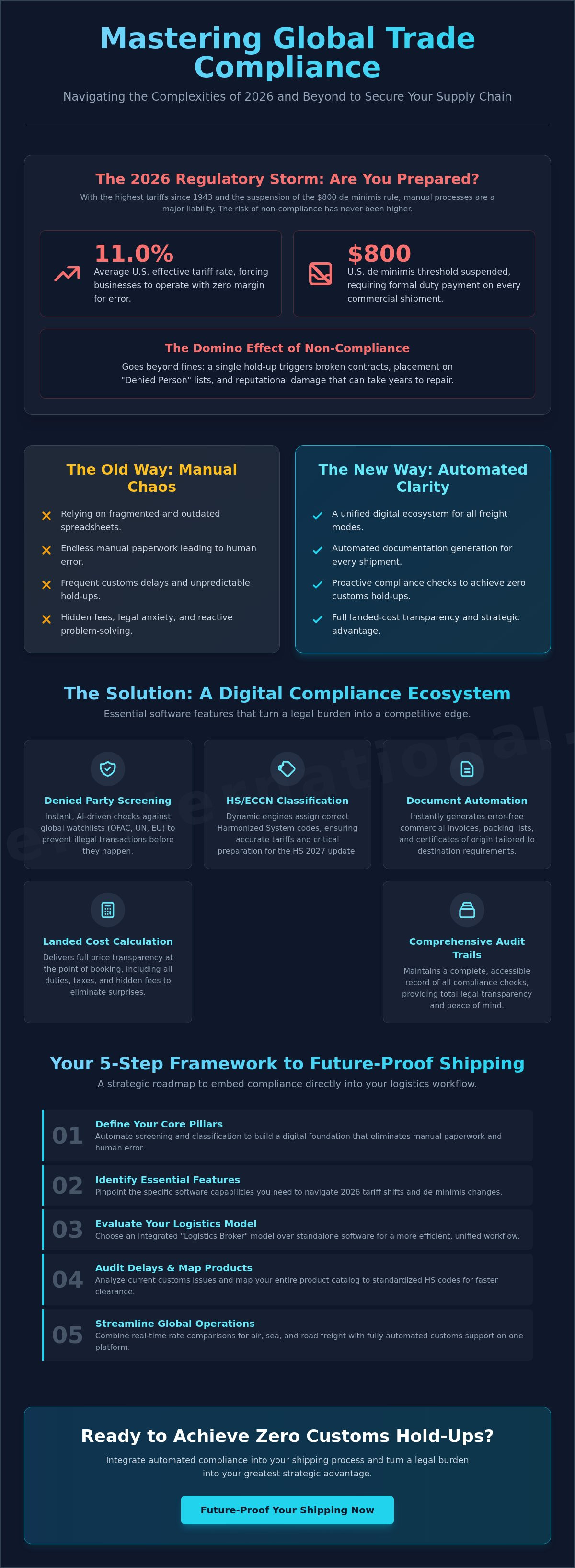
With the average effective tariff rate in the U.S. hitting 11.0% in early 2026, the highest since 1943, your margin for error has effectively vanished. You've likely felt the sting of the $800 de minimis suspension or the anxiety of tracking shifting denied party lists across fragmented spreadsheets. Managing manual paperwork while worrying about whether your next shipment will trigger a legal audit is exhausting, especially without the right international trade compliance software to guide you. You deserve a logistics process that moves as fast as your business does, without the constant fear of hidden fees or procedural friction.
This guide helps you master these complexities by moving trade compliance from a legal burden to a strategic logistics advantage. By leveraging automated tools, you can eliminate customs delays and generate accurate documentation for every shipment. We'll show you how to secure your supply chain against the 2026 regulatory shifts, including the critical prep for HS 2027, and build a unified dashboard for your express, air, road, and sea freight. You're about to discover how to achieve zero customs hold-ups and gain the peace of mind that comes with total legal transparency.
Key Takeaways
Define the core pillars of a digital compliance ecosystem, including automated screening and classification, to eliminate manual paperwork and human error.
Identify the essential features you need in international trade compliance software to navigate the complex tariff shifts and de minimis changes of 2026.
Evaluate the "Logistics Broker" model to see how integrating compliance directly into your shipping platform provides a more efficient workflow than standalone software.
Apply a five-step framework to audit your current customs delays and map your product catalog to standardized codes for faster clearance.
Streamline your global operations by combining real-time rate comparisons for air, sea, and road freight with automated customs support.
Table of Contents
What is International Trade Compliance Software in 2026?
Modern international trade compliance software is no longer just a digital filing cabinet for customs forms. It's a proactive digital ecosystem that automates the verification of global shipping regulations in real time. To understand the foundation of these rules, one must look at the framework of international trade compliance, which governs how goods cross borders under various federal and international agencies. In 2026, this software functions as an intelligent layer between your cargo and the global regulatory web.
The system stands on three core pillars that replace manual labor with automated precision:
Denied Party Screening (DPS): Instant cross-referencing of every recipient against global watchlists like OFAC, the UN, and the EU.
Product Classification (HS/ECCN): Dynamic engines that assign the correct Harmonized System codes to ensure you pay the right tariffs and avoid misclassification fines.
Document Automation: The immediate generation of commercial invoices, packing lists, and certificates of origin based on the specific requirements of the destination country.
The shift in 2026 is defined by AI-driven updates. Geopolitical sanctions now move faster than ever. A manual "check-the-box" method is too slow when a trade lane can be restricted in minutes. Modern software uses real-time verification to ensure your express shipping or sea freight remains compliant from the moment of booking until final delivery.
The High Cost of Non-Compliance
Financial penalties are only the beginning of the risk. If your business is found in violation of export controls, you could end up on a "Denied Person" list, which effectively halts your ability to conduct global trade. Many legacy providers, often operating under a "worldwide parcel inc" style model, focus solely on moving the box and leave the legal burden entirely on the shipper. This creates a dangerous gap in your supply chain. In a just-in-time economy, a single customs hold-up doesn't just delay one package; it triggers a domino effect of broken contracts and reputational damage that can take years to repair.
Why 2026 Requires a New Compliance Standard
The regulatory environment has evolved to include complex forced labor regulations and new environmental trade barriers. Relying on static spreadsheets for your international parcel shipping is now a major liability. For example, the 2026 reality includes the suspension of the $800 U.S. de minimis threshold, meaning every commercial shipment now requires formal entry and full duty payment. You need international trade compliance software that handles real-time data across 220+ countries and territories to navigate these sudden shifts. This level of automation provides the relief of knowing your road freight or air freight won't be sidelined by a regulation that changed while the truck was in transit.
Essential Features of Modern Trade Compliance Tools
Modern international trade compliance software must do more than just store data; it has to act as an automated gatekeeper for your entire supply chain. To effectively Comply with U.S. and Foreign Regulations, your toolkit needs to integrate directly into your booking workflow. This ensures that every air freight or road freight booking is verified against the latest legal standards before a label is even printed. By embedding these checks into your daily routine, you remove the typical anxieties of global logistics and replace them with a predictable, efficient process.
Automated Denied Party Screening: Constant monitoring against OFAC, UN, and EU watchlists to prevent illegal transactions.
Dynamic HS Code Engines: Precise classification to ensure correct tariff payments and critical preparation for the HS 2027 update.
Automated Documentation: Instant generation of commercial invoices and certificates of origin tailored to destination requirements.
Landed Cost Calculators: Full price transparency including duties, taxes, and fees provided at the point of sale.
Audit Trails: Comprehensive record-keeping that provides "safe harbor" protection during any regulatory audit.
Denied Party Screening: More Than a Simple Search
Screening isn't just a basic name check anymore. Modern tools use "fuzzy logic" to identify aliases, slight spelling variations, or phonetic matches that manual searches would miss. In 2026, compliance lists update daily to reflect fast-moving geopolitical shifts and new sanctions. This level of automation is vital for small business shipping solutions because it uses AI to filter out false positives. Instead of spending hours manually reviewing potential matches, your team can focus on growth. It's about keeping your logistics moving without the friction of constant manual oversight.
The Power of Automated Customs Documentation
Incorrect paperwork remains the primary cause of customs delays worldwide. High-quality international trade compliance software links your digital order data directly to the physical package. It generates commercial invoices and certificates of origin that meet specific destination requirements. By using electronic data interchange (EDI), the software communicates directly with major carriers like DHL, FedEx, and UPS. This digital handshake ensures that customs authorities receive accurate data before the shipment even arrives. If you're looking for a way to simplify this, our customs support provides a unified solution to bridge these technical gaps.
Finally, look for tools that offer a robust audit trail. This feature provides a chronological record of every screening and classification decision your business makes. With the average effective tariff rate in the U.S. reaching 11.0% in 2026, the stakes for accurate reporting have never been higher. This documentation serves as your "safe harbor" protection during a regulatory inquiry. It proves you exercised due diligence for every shipment, from sea freight to express shipping. This transparency doesn't just satisfy regulators; it builds trust with your partners and ensures your operations remain resilient against future legal changes.
Standalone GTM Software vs. Integrated Logistics Platforms
As the global trade compliance market grows toward a projected $2.19 billion in 2026, businesses face a critical choice. You can either purchase a standalone Global Trade Management (GTM) suite or use an integrated logistics platform where compliance is a built-in feature. Enterprise tools like SAP GTS or Visual Compliance offer deep customization, but they often come with a heavy administrative burden. For instance, SAP GTS 11.0 moved to customer-specific maintenance on January 1, 2026, forcing many users into costly migrations just to keep their regulatory data current. If you don't have a dedicated IT team to manage these updates, a standalone system can quickly become a bottleneck rather than a solution.
Integrated platforms represent a shift toward the "Logistics Broker" model. In this setup, international trade compliance software isn't a separate product you have to manage; it's a core component of your shipping workflow. Instead of paying monthly subscription fees for a software license, you benefit from compliance tools bundled directly into your air freight, sea freight, or road freight bookings. This model replaces the months-long implementation timelines of enterprise GTMs with a setup process that takes minutes. You gain the same level of legal security without the overhead of a standalone database.
Why Standalone Software Often Fails SMBs
The biggest hurdle for small and medium businesses is the "integration gap." A standalone tool might tell you that a shipment is compliant, but it doesn't talk to your shipping label printer. This disconnection forces your team to manually move data between systems, which is exactly where errors happen. Users who rely on "worldwide parcel inc" style legacy services find that adding a standalone compliance tool just adds another layer of friction to an already fragmented process. These hidden costs of manual data entry and software maintenance often outweigh any perceived benefits of a high-end enterprise suite.
The Rise of the Compliance-Ready Logistics Broker
Parcel International changes this dynamic by bridging the gap between wholesale shipping rates and automated customs support. We provide a single source of truth where your shipping rates, real-time tracking, and international trade compliance software live in one dashboard. This unified approach gives you the agility needed for complex parcel delivery abroad. You don't have to worry about whether your screening lists are updated or if your HS codes are correct; the platform handles the verification as you book. This transparency allows you to focus on your core business while we act as the stable intermediary in an increasingly volatile global market.
Implementing a Compliance Strategy: A 5-Step Framework
Transitioning from manual processes to a high-speed automated workflow requires a structured approach. In 2026, trade compliance isn't a task you complete once; it's a continuous cycle that must be embedded into your logistics DNA. To move from fragmented workflows to a unified solution, follow this five-step framework to secure your global operations.
Step 1: Audit your "customs pain points." Review your shipping history from the last 12 months. Identify exactly where your express shipping or road freight faced delays. Most hold-ups stem from inconsistent data or missing documentation.
Step 2: Map your product catalog. Assign standardized HS codes to every item you sell. Since 2026 is a critical preparation year for the HS 2027 update, getting this right now prevents a massive re-classification crisis later.
Step 3: Choose your partner. Decide if your volume requires standalone enterprise software or if an integrated logistics broker fits your need for speed and lower overhead.
Step 4: Automate screening. Set up international trade compliance software to automatically screen every new vendor, customer, and partner against global sanctions lists the moment they enter your system.
Step 5: Establish a "Compliance First" culture. Ensure your sales and procurement teams understand that compliance isn't a barrier; it's the engine that keeps shipments moving.
Mapping Your Product Catalog for 2026
If you manage thousands of SKUs, manual classification is impossible. Modern international trade compliance software uses AI classification tools to suggest the most accurate HS codes based on product descriptions. This is especially vital for identifying "dual-use" goods that might require specific export licenses. When your data is accurate, you avoid the "emergency" duty payments that often inflate your international shipping rates. Clean data at the catalog level ensures that every air freight or sea freight quote you receive is transparent and final.
Training Your Team for Automated Workflows
The goal of automation is to move your team from "manual data entry" to "exception management." Instead of typing out commercial invoices, your staff should only step in when the system flags a potential "red flag" or a screening match. This shift allows your business to scale without adding administrative headcount. When a query does arise, having a partner that provides expert customs support ensures that legal questions don't turn into shipping disasters. This approach provides the relief of knowing that while the software handles the volume, experts are ready to resolve any complex regulatory friction.
Future-Proof Your Shipping with Parcel International
Choosing the right international trade compliance software is only half the battle. The true advantage comes when that software is fused directly into your shipping engine. While standalone tax or legal tools provide data, they often stop at the most critical moment: the actual booking. Parcel International closes this gap by embedding compliance checks into every express shipping and sea freight order. You don't have to jump between platforms or manually verify if a destination has new restrictions. The system does the heavy lifting for you, ensuring that your road freight or air freight is cleared for departure before the carrier even arrives.
Scaling your business to 220+ countries and territories shouldn't require a dedicated legal team in every region. Our platform provides the stable intermediary you need to manage global volatility with confidence. By combining real-time rate comparisons with automated international trade compliance software, we provide a level of transparency that builds immediate trust with your global customers. They see the full cost, you see the full legal green light, and the entire process moves without the typical procedural friction of cross-border trade.
Automated Customs Documentation: The Parcel International Edge
The manual "worldwide parcel inc" style of compliance checks is a relic of the past that your business can't afford in 2026. Our automated document generation feature takes the data from your order and instantly produces commercial invoices and certificates of origin that meet specific local requirements. We prioritize customs support to ensure that delivery friction is minimized at every border. This automation doesn't just save time; it removes the anxiety of potential fines or seized goods. You gain a streamlined workflow where documentation is a byproduct of the booking process, not a separate, error-prone task.
Ready to Scale? Book Your Next Shipment Securely
Since 2007, we've focused on one mission: making global logistics simple and orderly. We provide the unique benefit of wholesale carrier rates from industry leaders like DHL, FedEx, and UPS, all while maintaining enterprise-grade compliance standards. This means you don't have to choose between cost-effective shipping and legal security. Whether you're a small business sending its first international parcel or a large-scale commercial project moving heavy freight, our platform adapts to your needs without the burden of subscription minimums or hidden fees. Take the final step toward a friction-free supply chain and optimize your global trade compliance and shipping today. You've mastered the complexities of the 2026 market; now it's time to let your logistics reflect that expertise.
Master Your Global Shipping Strategy Today
Global trade in 2026 demands a shift from manual oversight to automated precision. By embedding international trade compliance software directly into your logistics workflow, you replace the anxiety of customs delays with the relief of a predictable supply chain. You've learned how automated screening and accurate HS classification protect your business from the high costs of non-compliance. You also understand why an integrated logistics broker offers more agility than a fragmented standalone system. This move ensures your air freight, sea freight, or road freight remains compliant without the typical procedural friction.
It's time to move your business forward without the burden of hidden fees or administrative bottlenecks. Since 2007, we've provided automated customs documentation to help businesses scale securely across 220+ countries and territories. You deserve total transparency and reliable support at every border crossing. Start Comparing Rates and Automating Your Compliance with Parcel International. Take control of your global shipping today and experience the peace of mind that comes with a truly unified solution. Your journey to risk-free global shipping starts with a single, smart choice.
Frequently Asked Questions
What is the difference between GTM software and a logistics broker?
Standalone GTM software is an enterprise tool you license and manage internally, while a logistics broker integrates compliance as a built-in feature of the shipping experience. Brokers combine wholesale rates for air, sea, and road freight with automated regulatory verification. You don't have to manage separate software updates or migrations; the platform handles the legal data while you focus on moving your cargo.
How does international trade compliance software prevent customs delays?
Software prevents delays by automating the generation of accurate commercial invoices and verifying HS codes before you book. This ensures that customs authorities receive the correct data via electronic data interchange (EDI) before the package arrives. By using international trade compliance software, you eliminate the manual data entry errors that account for the majority of border hold-ups and shipment seizures.
Is automated denied party screening required for small businesses?
Every business is legally required to comply with export laws, regardless of its size or shipping volume. Small businesses are just as vulnerable to record-breaking fines for shipping to restricted entities or using incorrect tariff codes. Automated screening is the most efficient way to maintain "safe harbor" protection without hiring a dedicated legal team. It allows you to scale global sales with total peace of mind.
What is "worldwide parcel inc" and how does it relate to compliance?
This term describes legacy shipping models that only focus on the physical movement of goods from point A to point B. These providers leave the entire compliance and customs burden to the shipper, which often leads to unexpected delays and legal risks. Modern platforms replace this fragmented approach with a unified solution where customs support and regulatory verification are part of the standard booking process.
Can software automatically calculate import duties and taxes (Landed Cost)?
Yes, modern international trade compliance software provides real-time Landed Cost calculations during the checkout or booking process. This includes the base shipping rate plus all applicable duties, taxes, and local fees for the destination country. Providing this transparency upfront builds trust with your international customers and prevents shipments from being abandoned at customs due to unexpected costs.
How often are international trade sanction lists updated in 2026?
Trade sanction lists are updated daily in 2026 to keep pace with rapid geopolitical changes and new enforcement actions. Relying on static spreadsheets or monthly manual checks is no longer a viable strategy for global businesses. Automated tools sync with global databases in real-time to ensure every recipient is screened against the most current information before any labels are generated.
Does Parcel International provide automated customs documentation?
Parcel International provides fully automated customs documentation for every shipment booked through our platform. Whether you're using express shipping or sea freight, the system generates destination-specific commercial invoices and certificates of origin. This feature has been a pillar of our service since 2007, aiming to strip away the typical anxieties and friction associated with complex global logistics.
What happens if the software identifies a "Denied Party" match?
If a match is found, the system immediately flags the transaction and prevents the shipment from proceeding further. Your team then reviews the match to determine if it's a false positive or a legitimate legal restriction. This approach, known as exception management, ensures that high-risk shipments are stopped while your compliant orders continue to move through the supply chain without any delay.


